
Compressed Earth Block Construction: Turning Soil into a Sustainable Structure


Compressed Earth Block construction uses local soil and clay to create a naturally heat-regulating, moisture resistant structure. This low cost alternative could make sustainable construction more affordable in low income communities.
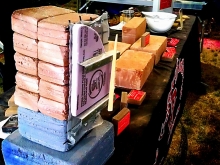
Compressed Earth Blocks (CEBs) are a type of manufactured construction material that can be made on-site in a mechanical press. The process combines soil, non-expansive clay, and aggregate into a compressed block. It typically contains 3-5% cement. CEB is great, low-cost construction material alternative because it can be made locally without the use of highly skilled labor and produces low carbon emissions. In fact, the process to construct with CEBs is 3-5 times less energy than construction with fired bricks.
When manufacturing CEBs, a 30% clay and 70% sand combination has proven reliable for raw rammed earth. Too much clay should not be used because then the wall can shrink and crack. The soil should not contain more than 10% moisture, since too much moisture can change the shape. Untouched, compressed-earth walls have the color and texture of natural earth. Moisture-impermeable finishes, such as cement render, are avoided because they impair the wall's ability to desorb moisture, necessary to preserve its strength.
Sustainability of CEBs
Soil is a widely available, low-cost and sustainable resource, and utilizing it in construction
has minimal environmental impact. Since compressed-earth structures use locally available materials, they usually have low embodied energy and generate very little waste. The soils used are typically subsoils which are low in clay and the topsoil can still be used for agriculture. The excavated soil from building's foundation can be used, as the cost and energy consumption for transportation are minimal. Local materials can also be used as natural plasters.
The high thermal mass of compressed earth walls act naturally to regulate the internal temperature of a building. CEBs absorb heat during the day and release it at night, which moderates daily temperature variations and reduces the need for heating and cooling. Compressed earth block construction contributes to the overall energy-efficiency of buildings. The density, thickness and thermal conductivity of compressed earth make it a particularly suitable material for passive solar heating.
The material mass and clay content of compressed earth makes the blocks naturally resistant to moisture and allows the building to "breathe" more than concrete structures do, avoiding condensation issues without significant heat loss. It also effectively controls humidity where unclad walls containing clay are exposed to an internal space. Humidity is held between 40% and 60%. However, in rainy climates, a rammed earth home needs additional insulation, as well as a larger roof, so that the overhangs protect the earthen walls.
In addition, compressed earth naturally regulates the internal relative humidity of the building, producing an improved air quality. This contrasts greatly with air conditioning systems, which act to dry the air in a building and contribute to harsh working and living environment.
The strength and durability of the wall results from the densification of a clay, sand, and
gravel matrix. The mass of the wall provides superior thermal and acoustic properties. As a result, they are also naturally earthquake resistant. However, wood or bamboo reinforcement should be employed in earthquake prone areas.
CEBs are naturally non-toxic, fireproof and biodegradable. Do not out-gas toxic chemicals as natural materials are used The thick walls are extremely fire resistant because there are no flammable components in the earth. In addition, everything has been packed so tightly that there's little chance of combustion. They are also naturally termite and rodent-resistant because they don't offer any food sources for insects or other vermin.
Disadvantages of CEBs
While CEBs have many merits, there are some qualities of CEBs that you should take into consideration before manufacturing them for your construction project.
First, manufacturers must properly identify the soil to find the correct mix of soil, clay and concrete, or the CEBs could crack or shrink. CEBs are labor intensive to construct without machinery, and are time-consuming to use in construction without mechanical tools. Very tall or wide buildings are difficult to construct with CEBs, even with the correct equipment.
The technical performance of CEBs are low when compared to concrete. They can lack stability if they are poorly made with unadapted or bad production equipment. Structural cracks can result from water penetration, which is why additional insulation and roofs are needed in rainy climates.
Because compressed earth uses naturally occurring materials, the exterior isn't all one color. It wouldn't be jarringly different, but there might be some slightly lighter or darker places on the exterior surfaces.
Connect.
Find LEED consultants and professionals with green building skills and experience.
Meet Pros.


Learn.
Relevant education and training to consider.
News.


Why join Poplar Network?

- Learn about green building
- Save on LEED exam prep
- FREE continuing education
- Join the conversation
- Connect with peers