
Inbound Marketing and Your Green Business


As an inbound marketer, you can educate and sell simultaneously, and you don't need deep pockets to do it.
"People don't like to be sold, but they love to buy." - Jeffrey Gitomer
Considering that the FTC reported this year that over 2/3 of Americans are on the "Do Not Call" list, nearly 90% of people skip TV ads, and 94% of the links that people click on in the search engine results pages (SERPs) are organic, not paid, sales guru Jeffrey Gitomer certainly seems to be right. Conversely, approximately 50% of shoppers spend 75% of their time researching products online before they buy.
So, when communicating with your customers and prospects, should you be in sales mode or education mode?
As an effective inbound marketer, you can educate and sell simultaneously, and you don't need deep pockets to do it. Inbound marketing (aka "permission marketing" for the Seth Godin fans out there) is the practice of creating and optimizing digital content that your prospects are most interested in so they can find it when they are searching for it online.
When it comes to influencing, attracting or transacting with your future customers, the most effective inbound marketing technique is blogging. By creating relevant original content and optimizing it for search engines, you can not only begin to build trust with new customers and create lasting value for your brand, but also build traffic to your site. Following up on three factors in "on-page" Search Engine Optimization (SEO), we'll also look at how SEO and inbound marketing affect your customer sales funnel.
Inbound Marketing and the Sales Funnel
The 2011 "Lead Generation Lessons" report from Hubspot states that businesses that blog at least 20x per month receive 5x more traffic than those that don't. But before you develop your content strategy, stop and consider that there are several stages of readiness your new customers may be in when doing research online.
The concept of the sales funnel has been around for over 100 years... The basic premise is that all your prospects go through several steps in the process of becoming your customer. For instance, if you are a property management firm marketing to be known for LEED or green building expertise, your future customers could be searching online while they are in any of the following stages of your "sales funnel":
1) Awareness: I've heard of this thing called "green building"
2) Interested: I'm interested in learning about "LEED"
3) Desire/Decision: I'm a building owner and want to know about the ROI associated with green property management
4) Action: Looking for a property manager who understands this stuff
The classic sales funnel is an inverted pyramid and looks like this:
While the sales funnel was originally conceived as a way to evaluate the effectiveness of print advertisements, it's also helpful as a tool for thinking of the stages of interest your future customers may be in or be going through.
Indeed, in real estate and green building, the sales cycle can be much longer because of high dollar values associated with buying services, property or investing in construction and repairs, so your sales funnel may have any number of stages. Regardless, you can customize your funnel, and your content strategy, accordingly to fit your business and how your customers go from "Awareness" to final "Action".
Building Your Content
Depending on your industry and how competitive your market is, you'll want to do some keyword research before you start writing your inbound marketing content. For this article, we'll just focus on getting people in the top of the sales funnel.
If you are starting at the "awareness" phase, you might craft a general article about LEED or the benefits of green building. However, because those are general keywords and competitive terms, it may not make sense to invest in trying to rank for the term or you may only receive a small portion, if any, of the organic traffic based on your post. You can use Google's Keyword Tool to get a sense of how much search volume there is for a particular search term and get a sense of its competitiveness. An alternative keyword research tool you can look at is "Ubersuggest", which can help you generate ideas.
Exploring long tail keywords (more specific phrases, such as "LEED EBOM 2009 IEQp3" - the "green cleaning credit" - approximately 2,900 phrase match searches per month) that may be easier to rank for if you have a strategy around it.
For instance, in our "green property manager" example, after doing some research you may discover that the phrase "demand response" is searched for over 20,000 times per month, but appears to have low competition. Since there is a clear ROI associated with these programs you could write a special report about how a Demand Response program could be beneficial to property managers because it can help the owner generate incremental revenue, while potentially reducing operating costs. Demand response programs vary widely by state, utility and type of program so the amount of granularity you can explore with such a topic is almost endless. When you create your special report, you can provide the content entirely in a blog post, for easy reading, or (depending on your ultimate goals) include a link to download a more in-depth analysis of conditions and trends in the demand response industry.
Ultimately, the key is to make a connection in a busy world and, in this case, to come across as thinking like a building owner or investor would want his property manager to think!
The more effectively you can connect with your prospect, the more likely you are to have them engage with you in other ways, such as by requesting more information or placing a call, or just by visiting your site again in the future. By getting your new prospects into the top of your conceptual "sales funnel" you are making them aware of your business in some way and hopefully starting some sort of relationship with them.
What do you think?
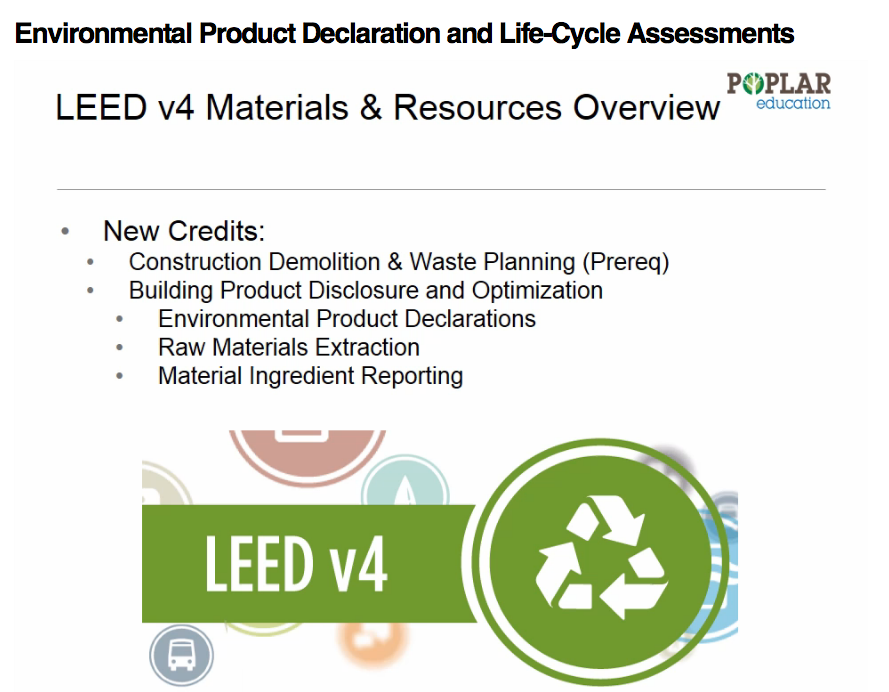
LEED v4 takes green products to the next level.
Learn about how Environmental Product Declarations (EPD) and Life Cycle Analysis (LCA) affects your green building product marketing process in this FREE training course for Poplar members.
Connect.
Find LEED consultants and professionals with green building skills and experience.
Meet Pros.


Learn.
Relevant education and training to consider.
News.


_itok-GdAYtPyq.JPG)

Why join Poplar Network?

- Learn about green building
- Save on LEED exam prep
- FREE continuing education
- Join the conversation
- Connect with peers