
Wind Towers: Energy-Free Air Conditioning in Hot Climates


Wind is an important source of energy. Even though it is irregular and can blow from any direction, at any speed and at any strength.
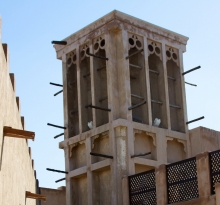
In certain climates, an architectural wind tower turns the unpredictable "liability" into an asset because it collects wind from every direction, at any time and at any speed.
A wind tower is an architectural element used in traditional building design to provide natural ventilation. Wind towers are mainly used in hot, hot-dry and hot-humid climates and look similar to chimneys and have vertical shafts with vents on top. A wind tower is essentially a tall, capped tower that catches the wind, bringing it down into the tower into the heart of the building to maintain air flow, thus cooling the interior of the building. This is the most direct way of drawing air into the building, but relies on a rate of air flow to provide a cooling effect. Inside, there are several vertical air passages, and the air is guided into each passage by internal partitions and shafts. Architectural wind towers also operate in reverse, primarily using the stack effect, pulling hot air up through a building and bringing fresh cool air in from the bottom.
Wind towers require very little or no energy to maximize ventilation. Wind tower performance is completely dependent on wind availability, and backup power supplies are not needed to maintain the benefits of a wind tower. Since wind is free and little or no energy is used, wind towers can provide air conditioning at a very small or nonexistent operational cost – and with very few, or zero, carbon emissions. Plus, there is no noise due to the absence of fans, and no mechanical parts are used that would require maintenance.
Architectural wind towers improve indoor air quality because they constantly bring fresh air into the building instead of recirculating indoor air. They use fresh air above roof level, which is relatively clean and free from contamination, as compared to the dust, dirt and pollutants that may be more commonly found at ground level. Unlike air conditioning, which can be uncomfortable and an added expense, wind towers maintain a constant indoor air temperature.
Design
Wind towers tend to have one, two, four, or eight openings. The construction of a wind tower depends on the direction of airflow at that specific location. If the wind tends to blow from only one side, it is built with only one downwind opening. To keep buildings free of blowing dust and sand, wind towers are built facing away from the wind in certain locations.
- Uni-directional towers are built on sloping roofs. Each has one or two vents only, which are generally positioned to north-west or north direction.
- Bi-directional towers are divided into two shafts by vertical brick partitions. These wind towers with two vents are often referred to by their direction, such as “north-south towers”.
- Multi-directional towers have four or more sides with four opening to catch the wind from any direction. Air circulation can be adjusted by opening or closing one or more of the vents. They’re used in hot humid regions.
Function
The function of wind tower is to catch cooler air that prevails at a higher level above the ground, directing it into the interior of buildings. The wind tower can function in three ways:
- Directing airflow downward using direct wind entry to catch the wind and bring it down the tower into the heart of the building to maintain airflow, thus cooling the building interior. It does not necessarily cool the air itself, but rather relies on the rate of airflow to provide a cooling effect.
- Wind-assisted temperature gradient operates in combination with an underground canal. The open side of the tower faces away from the direction of the prevailing wind. By keeping only this tower open, air is drawn upwards. The pressure differential on one side of the building causes air to be drawn down into the passage on the other side. In hot climates that are also dry, a wind tower can increase its effectiveness by utiliizing evaporative cooling if the tower collects air which is then brought down into the tunnel and is cooled by coming into contact with the cool earth and cold water running through the canal. The cooled air is drawn up through the wind tower.
- Solar chimney design may be used in a windless environment or waterless house. A wind tower can function as a solar chimney by creating a pressure gradient that allows less dense hot air to travel upwards and escape out the top. This makes the environment much cooler below.
Disadvantages of Wind Towers
Though wind towers provide air conditioning for very little energy, the downside is that their efficiency is very low in the absence of wind. The strength of the wind is not constant, and can vary from zero to storm force.
Another disadvantage of wind towers are that in multi-directional wind towers, part of the air entering the building can exit through other openings. Also, dust, insects and small birds can enter the building through the tower’s openings.
Connect.
Find LEED consultants and professionals with green building skills and experience.
Meet Pros.


Learn.
Relevant education and training to consider.
News.


Why join Poplar Network?

- Learn about green building
- Save on LEED exam prep
- FREE continuing education
- Join the conversation
- Connect with peers