
Comparing Energy in Rating Systems for Sustainable Design


When considering a sustainable building, designers can choose from various green building rating systems. This article looks at the impact of energy in each.
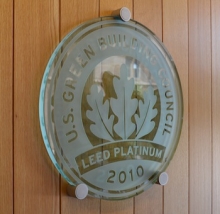
As most of North America’s industry struggles to emerge from recession, the green building market continues to surge forward.
Whether you believe the reports that the industry is $36 billion or $116 Billion, it’s obvious the market is a big, bright spot in the American economy.
In some industries, such as consumer products, it’s easy to make assumptions about the cause of rapid or steady growth. Proctor & Gamble and Frito Lay will always do well, because as the population grows, more people need to eat and brush their teeth. But in green building it’s not so simple...
So, why has the green building industry been so successful? Americans didn’t all wake up one morning and put solar panels on their homes, or decide that they wanted to live in a tiny house, or go green no matter what.
No, I believe that a large part of green building success has to do with green building ratings systems, such as LEED.
Comparing Green Building Rating Systems
Green building ratings systems accomplish two important things for us. First, they simplify things. Green building rating systems offer a convenient framework for understanding sustainability, which is a very complex subject. Second, tiered certification levels within green building rating systems create a forum for competition. Humans like games and striving to be the best is a kind of game. A LEED Certified building just isn’t as “good” as a LEED Platinum building.
Green building rating systems offer frameworks or sets of metrics from which to evaluate the sustainability of a building. They often set priorities or offer formulas for weighting areas of design.
Green building rating systems evaluate aspects of sustainable design within a building through major categories, such as energy efficiency, water efficiency, materials, air quality, site, and so forth. This can be very helpful when designing a new project or working with an existing building, and luckily, there are numerous green building rating systems to choose from that can do just that.
Over a series of articles, I’ll compare the major green building rating systems and consider how they treat these major sustainability categories. The four major rating systems we’ll focus on are:
- LEED® v4 Building Design and Construction (BD+C)
- Green Globes™ New Construction (NC)
- Living Building Challenge
- ENERGY STAR
We’ll go through, in no particular order, the five major areas of sustainability as it pertains to buildings:
- Site
- Water
- Energy
- Materials
- Indoor Environment
In this article, we’ll look at the energy category.
Leadership in Energy and Environmental Design
LEED® is by far the most well known and recognized of the green building rating systems. LEED uses a points based hierarchy to determine various, increasingly higher, levels of building certification.
In order for a building to achieve certification, LEED requires meeting several prerequisites, as well as a minimum number of points.
The “Certified” level is the lowest level of LEED certification and additional points may be earned to achieve increasingly higher levels of certification. “Certified” (40-49 points), “Silver” (50-59 points), “Gold” (60-79 points), or “Platinum” (80-110 points).
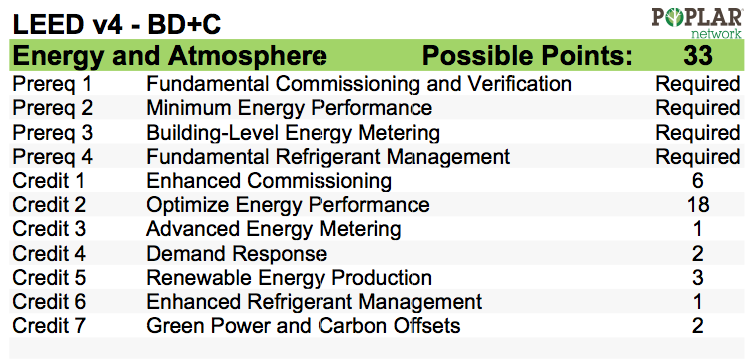
LEED evaluates energy use in the Energy & Atmosphere (EA) Category. There are 33 total potential points available. If a building is seeking to earn the minimum level of certification, or “Certified”, accumulating points in the EA category alone could supply 82.5% (33/40) of the total points required for certification, in addition to meeting the required prerequisites. If the highest level of certification was attained (Platinum), the EA category could supply at least 41.25% (33/80) of the total points required.
Green Globes
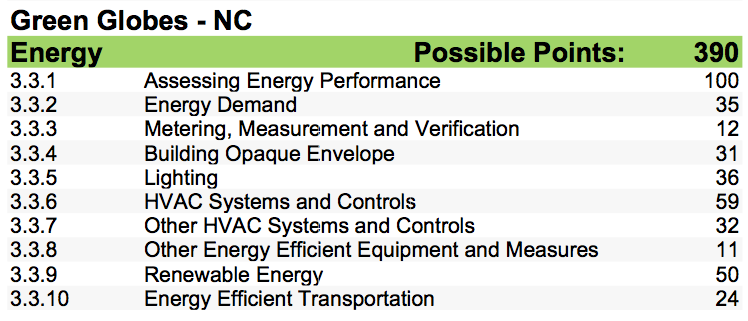
Green Globes™ is also a voluntary rating system, however unlike LEED® there are no prerequisites required. There are 1000 total points available in the Green Globes™ rating system, with 390 points available in the Energy category. Like LEED®, there are four levels of certification. Buildings that achieve at least 350 of the 1000 points are eligible for the minimum level of certification, earning a rating of “One Globe.” Buildings that achieve at least 550 points will earn “Two Globes,” while buildings achieving at least 700 points will earn “Three Globes.” Lastly, a building that achieves at least 850 points will earn the highest level of “Four Globes.” Therefore, in the Green Globes™ system, simply achieving all of the points in the Energy category would earn a certification level of “One Globe,” and would account for 45.8% (390/850) of the required points to earn the highest level of certification.
Living Building Challenge
The Living Building Challenge has several “petals”, or categories, similar to LEED® and Green Globes™. However, in this rating system, a building can be certified three different ways: Either Full certification, “Petal” recognition, or Net Zero Energy Building Certification. There are seven “Petals”: Site, Water, Energy, Health, Materials, Equity, and Beauty. Within these seven petals, there are twenty “imperatives” which must be met, similar to a LEED® credit.
However, in order to reach Full Certification in the Living Building Challenge, all twenty imperatives must be met. In order to attain Petal recognition, the project must satisfy the requirements of three or more petals, and at least one of the following must be included: Energy, Water, or Materials. The Energy Petal includes only one imperative: Attain Net-Zero Energy status. This means that one hundred percent of the building’s energy needs must be supplied by on-site renewable energy on a net annual basis. As stated previously, projects can also simply attain Net Zero Energy Building Certification.

ENERGY STAR
The ENERGY STAR rating system only focuses on the energy efficiency of buildings, it does not take into account any of the other factors common to sustainable design, such as the impact a building has on its surrounding area, water efficiency, air quality, or materials. In order to be eligible for ENERGY STAR certification, a building must earn an ENERGY STAR score of 75 or better, meaning that the building performs better than at least 75 percent of similar buildings nationwide.
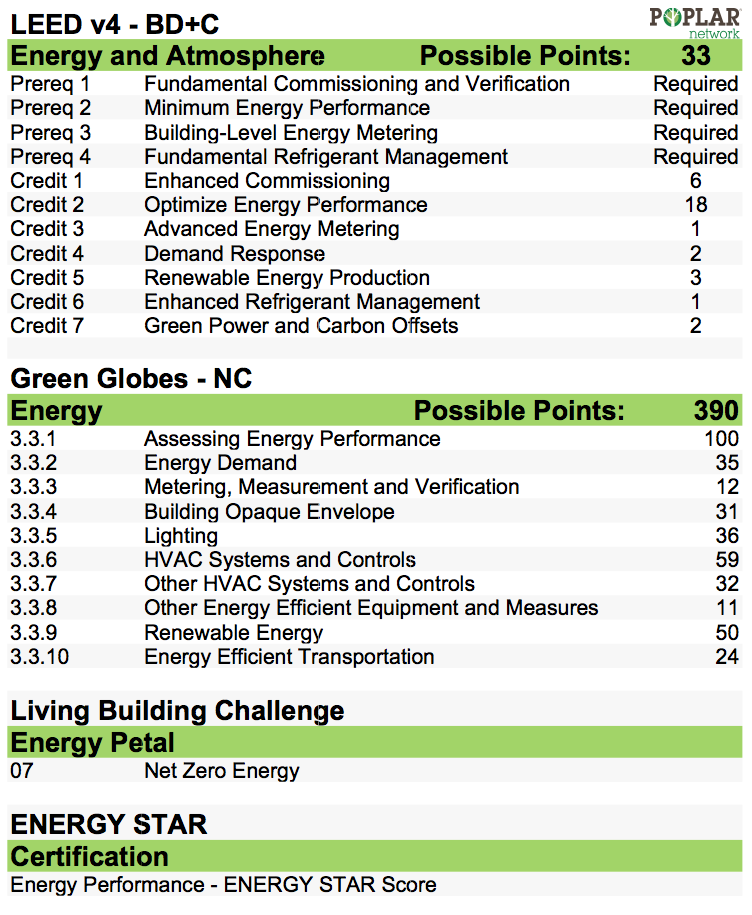
 It's helpful to be able to see the differences in the various rating systems at a glance. The following table illustrates the various credits within the energy categories for the four different rating systems. The main comparison is between LEED® and Green Globes™. Both rating systems have similar features, such as energy performance, commissioning, demand response, measurement and verification, renewable energy, and refrigerant usage.
Green Globes™ also includes a section for lighting in its energy category, as well as a section for the building envelope which addresses passive design. Lastly, Green Globes™ includes an additional section for “other energy efficient equipment and measures.” In LEED®, the “Optimize Energy Performance” credit is worth 54.5% of the total points in the category, whereas in Green Globes™, the “Assessing Energy Performance” credit is worth 25.6% of the total points in the category. Therefore, the LEED® rating system is weighted more heavily in the energy performance area than Green Globes™ is. You can see the weight each of the credits in the energy category in the table below.
Connect.
Find LEED consultants and professionals with green building skills and experience.
Meet Pros.


Learn.
Relevant education and training to consider.
News.


Why join Poplar Network?

- Learn about green building
- Save on LEED exam prep
- FREE continuing education
- Join the conversation
- Connect with peers