
LEED v4 Encourages Efficient Natural Resource Use


LEED v4 BD+C emphasizes minimizing the embodied energy associated with extraction, processing, transport, maintenance and disposal of building materials.
Global Background
In May 2011, the United Nations Environment Programme’s International Resource Panel (UNEP IRP) published a report entitled “Decoupling Natural Resource Use and Environmental Impacts from Economic Growth.” The report warns that humanity’s rate of natural resource consumption is unsustainable. It approximates that human beings currently consume a total of 47 billion tons of minerals, ores, fossil fuels and biomass per year. In the report, the panel predicts that, by 2050, this figure will increase threefold, to 140 billion tons per year.
Country-specific Differences
An individual’s contribution to this global consumption can vary considerably.
The panel notes in the report that individuals in developed countries consume, on average, 16 tons of the four aforementioned natural resources annually. Average individual consumption in certain developed countries, on the high end of the resource consumption spectrum, peaks at over 40 tons annually. In contrast, an individual in India consumes, on average, 4 tons annually.
In addition to the amount of consumption, the type of consumption can differ significantly. Wood use is an illustrative example. The Association for the Advancement of Science (AAAS) notes in its Atlas of Population and Environment that wood is used for very different purposes around the world. Developed countries, including Finland, the largest per-capita consumer of raw timber, process wood to use it as paper and packaging. In contrast, many developing nations depend upon wood for construction and fuel.
LEED v4’s Contribution
LEED v4’s BD+C: New Construction Materials and Resources credit category encourages efficient natural resource use through “minimizing the embodied energy and other impacts associated with the extraction, processing, transport, maintenance, and disposal of building materials.”
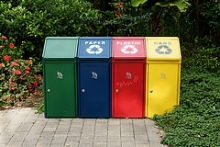
The credit category’s first requirement is titled Storage and Collection of Recyclables and mandates that areas are allocated for the collection and storage of recyclables, including mixed paper, corrugated cardboard, glass, plastics and metals, and that the areas are accessible to haulers to remove the material for processing and recycling.
The credit category’s second requirement supports the recovery, reuse and recycling of all materials during construction and demolition through the development and implementation of a comprehensive waste management plan.
In addition to these two requirements, the credit category includes 5 optional credits. The Building Life-Cycle Impact Reduction credit offers the most points and focuses on the reuse and/or renovation of as much of an existing building and its materials as possible. The category’s next three optional credits are Building Product Disclosure and Optimization credits and require the sourcing of raw materials and the use of material ingredients and environmental products to be reported and to meet a USGBC-specified standard. The category’s final credit, Construction and Demolition Waste Management, offers additional credit for diverting 50-75% of the project’s nonhazardous construction and demolition materials from landfills and incinerators.
Conclusion
The UNEP IRP’s report urges humanity to “decouple” natural resource consumption and economic development and prosperity by investing in the use and continued development of technological and social advancements.
Such innovations are empowering countries such as China, India and Brazil to realize increasing rates of development in the late twentieth and early twenty-first centuries. Projects receiving credits from LEED v4’s Materials and Resources credit category can be examples of innovative development that minimizes natural resource consumption.
With such a large percentage of the world’s population experiencing rapid societal change and development, a focus on efficient growth is paramount to creating a world with sustainable natural resource consumption.
References
The information included in this article from UNEP IRP’s report can be found here: http://www.unep.org/resourcepanel/publications/decoupling/tabid/56048/de...
Information from the Association for the Advancement of Science (AAAS) Atlas of Population and Environment was sourced from: http://atlas.aaas.org/?part=2
LEED v4 takes green products to the next level.
Learn about how Environmental Product Declarations (EPD) and Life Cycle Analysis (LCA) affects your green building product marketing process in this FREE training course for Poplar members.
Connect.
Find LEED consultants and professionals with green building skills and experience.
Meet Pros.


Learn.
Relevant education and training to consider.
News.


Q&A.


Why join Poplar Network?

- Learn about green building
- Save on LEED exam prep
- FREE continuing education
- Join the conversation
- Connect with peers