
Comparing Water in Rating Systems for Sustainable Design


When considering a sustainable building, designers can choose from various green building rating systems. This article looks at the impact of water efficiency in each.
Green building rating systems offer frameworks or sets of metrics from which to evaluate a level of sustainability that a building can attain, as well as set priorities for or weight certain areas of design. Luckily, there are numerous green building rating systems to choose from that can do just that.
Green building rating systems evaluate aspects of sustainable design within a building through major categories, such as energy efficiency, water efficiency, materials, air quality, site, and so forth.
Over a series of articles, I’ll compare the rating systems and consider how they treat these major categories. The three major rating systems we’ll focus on are:
- LEED® v4 Building Design and Construction (BD+C)
- Green Globes™ New Construction (NC)
- Living Building Challenge
In my last article, I compared green building rating systems in the Energy Efficiency category. In this article, we’ll examine the Water Efficiency category.
LEED Version 4 Building Design + Construction (BD+C)
LEED® is a voluntary rating system that uses a points-based system to determine various, increasingly higher, levels of certification. LEED has several prerequisites that must be met, as well as a minimum of points that must be earned to reach the “Certified” level.
Additional points may be earned to achieve increasingly greater levels of certification. “Certified” (40-49 points), “Silver” (50-59 points), “Gold” (60-79 points), or “Platinum” (80-110 points). In the Water Efficiency (WE) Category, there are 11 total potential points available. Therefore, just to meet the “Certified” level, the WE category alone could supply 27.5% (11/40) of the total points required, in addition to meeting the required prerequisites. If the highest level of certification was attained (Platinum), the WE category could supply just 13.75% (11/80) of the total points required.
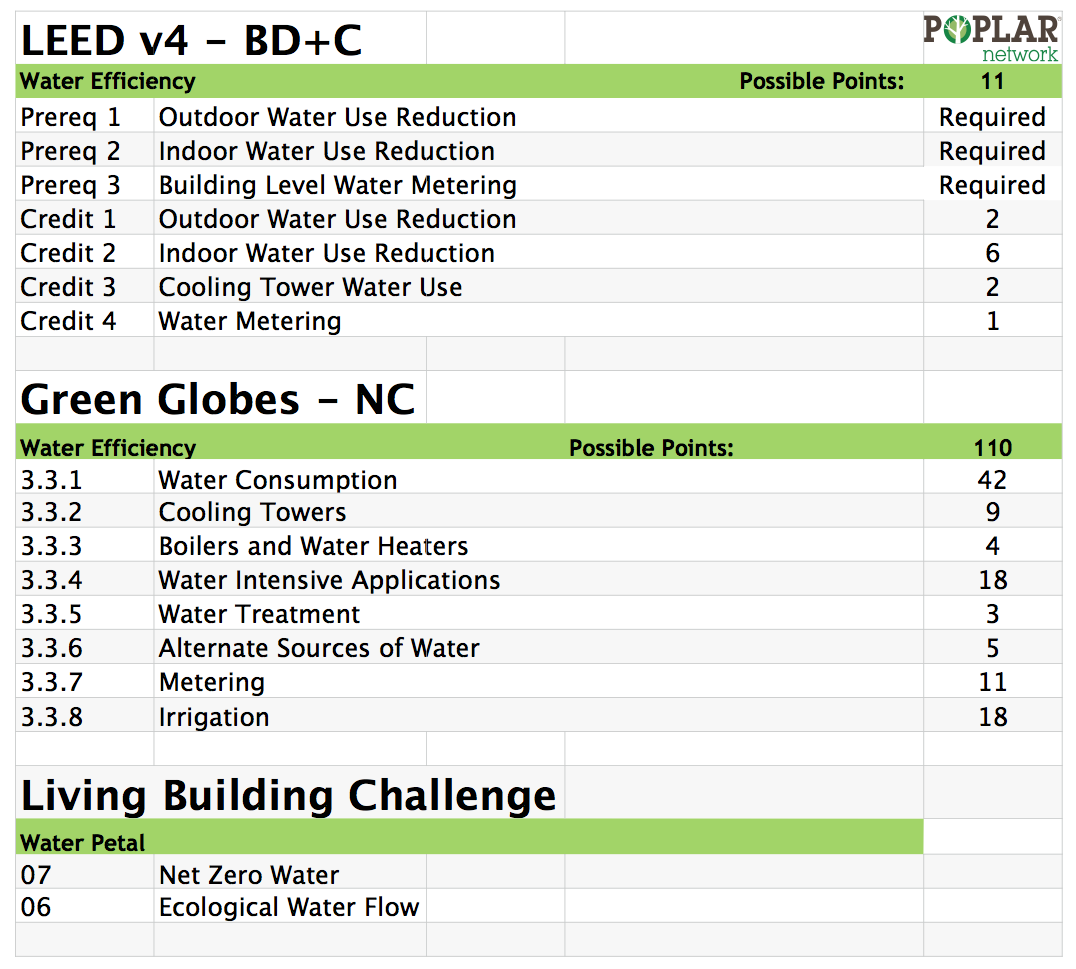
Here is a list along with a brief description of the credits within the LEED® v4 BD+C WE category.
WE Prerequisite: Outdoor Water Use Reduction (Mandatory) The intent of this prerequisite is to reduce outdoor water consumption using various methods such as permeable pavement or landscaping that does not require irrigation.
WE Prerequisite: Indoor Water Use Reduction (Mandatory) The intent of this prerequisite is to reduce indoor water use consumption, mainly through using plumbing fixtures with reduced flow rates.
WE Prerequisite: Building Level Water Metering (Mandatory) This prerequisite’s intent is to monitor water consumption in order to track usage and identify water savings areas.
WE Credit: Outdoor Water Use Reduction (Up to 2 points - 18% of category total)
The intent of this credit is to further reduce outdoor water usage beyond the prerequisite levels. The Green Globes™ related credit is Credit 3.4.8 – Irrigation.
WE Credit: Indoor Water Use Reduction (Up to 6 points – 54% of category total)
The intent of this credit is to further reduce indoor water usage beyond the prerequisite levels. The Green Globes™ related credit is Credit 3.4.1 – Water Reduction
WE Credit: Cooling Tower Water Use (Up to 2 points – 18% of category total)
The intent of this credit is to reduce the amount of water used for cooling tower makeup water. (The Green Globes™ related credit is Credit 3.4.2 – Cooling Towers.)
WE Credit: Water Metering (1 point – 10% of category total)
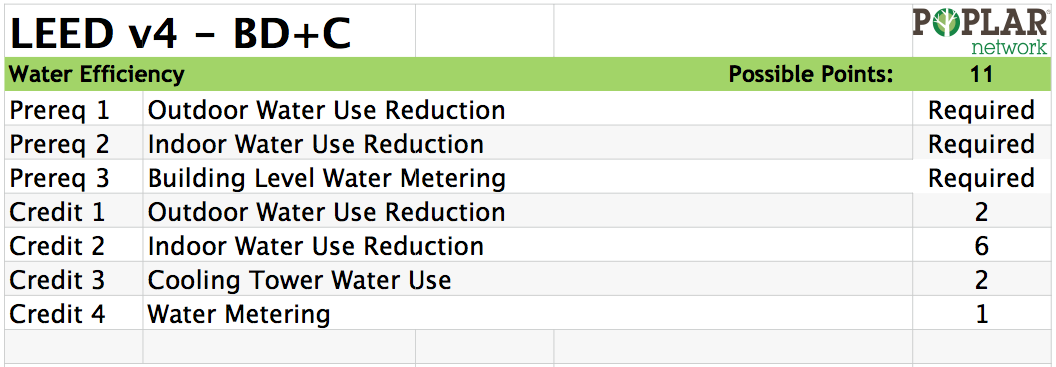 This credit’s intent is to monitor water consumption in order to track usage and identify water savings areas, and goes beyond the prerequisite requirements to monitor water subsystems as well as the overall building system. (The Green Globes™ related credit is Credit 3.4.7 – Metering.)
Green Globes - New Construction
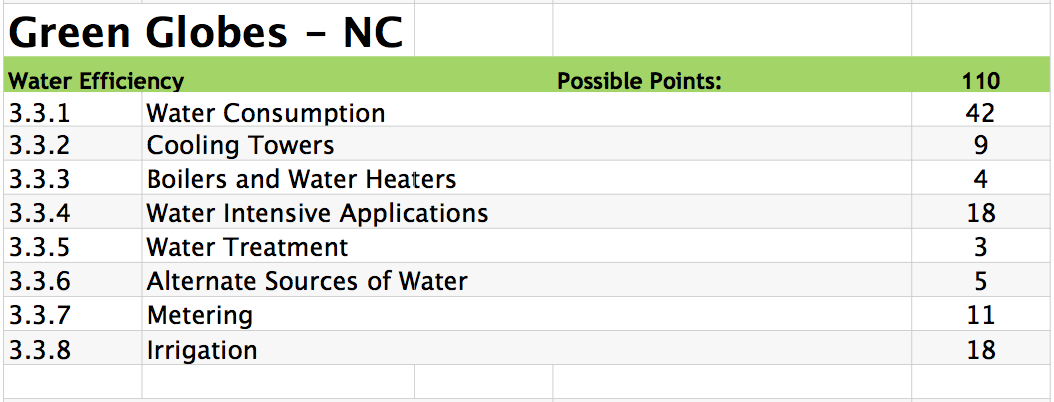
Green Globes™ is also a voluntary rating system, however unlike LEED® there are no prerequisites required. There are 1000 total points available in the Green Globes™ rating system, with 110 points available in the Water category. Like LEED®, there are four levels of certification. Buildings that achieve at least 350 of the 1000 points are eligible for certification, earning a rating of “One Globe.” Buildings that achieve at least 550 points will earn “Two Globes,” while buildings achieving at least 700 points will earn “Three Globes.” Lastly, a building that achieves at least 850 points will earn the highest level of “Four Globes.” Therefore, in the Green Globes™ system, achieving all of the points in the Water category would account for 31.4% of the points required to earn “One Globe,” and would account for 12.9 % (110/850) of the required points to earn the highest level of certification.
Here is a list along with a brief description of the credits within the Green Globes™ New Construction Water category:
Credit 3.4.1 Water Consumption (Up to 42 points – 38% of category total)
The intent of this credit is to reduce indoor water use consumption, mainly through using plumbing fixtures with reduced flow rates. The LEED® related credit is WE Credit: Indoor Water Use Reduction.
Credit 3.4.2 Cooling Towers (Up to 9 points -8% of category total)
The intent of this credit is to reduce the amount of water used for cooling tower makeup water. (The LEED® related credit is WE Credit: Cooling Tower Water Use.)
Credit 3.4.3 Boilers and Water Heaters (Up to 4 points - 4% of category total)
The intent of this credit is to minimize the amount of water lost, or to reuse water in a boiler/heating system. (There is no LEED® related credit.)
Credit 3.4.4 Water Intensive Applications (Up to 18 points - 16% of category total)
The intent of this credit is to reduce the amount of water used in water intensive equipment such as food service, laboratory, medical, laundry, or special water features. (There is no LEED® related credit.)
Credit 3.4.5 Water Treatment (Up to 3 points - 3% of category total)
The intent of this credit is to utilize efficient filtration systems or water softeners. (There is no LEED® related credit.)
Credit 3.4.6 Alternate Sources of Water (Up to 5 points - 5% of category total)
The intent of this credit is to reuse or reclaim water for nonpotable use. (There is no LEED® related credit.)
Credit 3.4.7 Metering (Up to 11 points - 10% of category total)
This credit’s intent is to monitor water consumption in order to track usage and identify water savings areas. (The LEED® related credit is WE Credit: Water Metering.)
Credit 3.4.8 Irrigation (Up to 18 points - 16% of category total)
The intent of this prerequisite is to reduce outdoor water consumption using various methods such as rainwater harvesting or landscaping that does not require irrigation. (The LEED® related credit is WE Credit: Outdoor Water Use Reduction.)
Living Building Challenge
The Living Building Challenge has several “petals”, or categories, similar to LEED® and Green Globes™. However, in this rating system, a building can be certified three different ways: Either Full certification, “Petal” recognition, or Net Zero Energy Building Certification. There are seven “Petals”: Site, Water, Energy, Health, Materials, Equity, and Beauty. Within these seven petals, there are twenty “imperatives” which must be met, similar to a LEED® credit. However, in order to reach Full Certification in the Living Building Challenge, all twenty imperatives must be met. In order to attain Petal recognition, the project must satisfy the requirements of three or more petals, and at least one of the following must be included: Energy, Water, or Materials. The Water Petal includes the following two imperatives:
05 Net Zero Water The intent of this petal is for one hundred percent of the building’s water needs must be supplied by captured precipitation or other natural closed loop water systems.
06 Ecological Water Flow The intent for this petal is for one hundred percent of storm water and used, project water discharge must be managed onsite to feed the project’s internal water demands or released onto adjacent sites for management through acceptable natural time-scale surface flow, groundwater recharge, agricultural use or adjacent property needs.

Smith College's Bechtel Environmental Classroom in Whately, Massachusetts is a new, 2,500 S.F. single-story wood-framed classroom building that recently achieved full certification in the Living Building Challenge. Many strategies were used to achieve the imperatives of the Water petal, including water efficient plumbing fixtures, 80% gray water use for irrigation, composting toilets and a leach field for septic tank discharge.
In the prior article comparing energy, we also included ENERGY STAR. There is no water efficiency metric within ENERGY STAR so that has been excluded in this article.
 Learn about how LEED addresses water efficiency technologies in the "Water Use Reduction" credit (aka Indoor Water Use Reduction in LEED v4) which is relevant to every LEED rating system. Experienced LEED consultant Alex Spilger guides you along the way as you work on an actual LEED project. You'll Earn 2 Continuing Education Units (CEUs) in as little as 45 minutes. Only $29.95!
Connect.
Find LEED consultants and professionals with green building skills and experience.
Meet Pros.


Learn.
Relevant education and training to consider.
News.


Why join Poplar Network?

- Learn about green building
- Save on LEED exam prep
- FREE continuing education
- Join the conversation
- Connect with peers