
What is the Sustainable Risk Management Process?


Green, or Sustainable Risk Management is a process that provides a new set of tools to generate effective sustainability strategies and tactics.

It starts with a vision. Interface Inc’s Ray Anderson had one, a life altering vision he called “Mission Zero”.
It was to eliminate Interface’s negative environmental impact by 2020 while generating an enviable operating profit.
While there is still more to do, Ray succeeded beyond anyone’s wildest expectations. His company continues to climb Ray’s "Mt Sustainability", creating exciting new products and dramatically reducing their environmental footprint.
The vision was the easy part. Getting there, climbing the mountain is where the going gets tough.
The Sustainability Risk Management (SRM) process helps you begin your sustainability journey. It follows the time tested risk management process, only it is modified to include sustainable opportunities and benefits.
Two Sides of the Same Coin
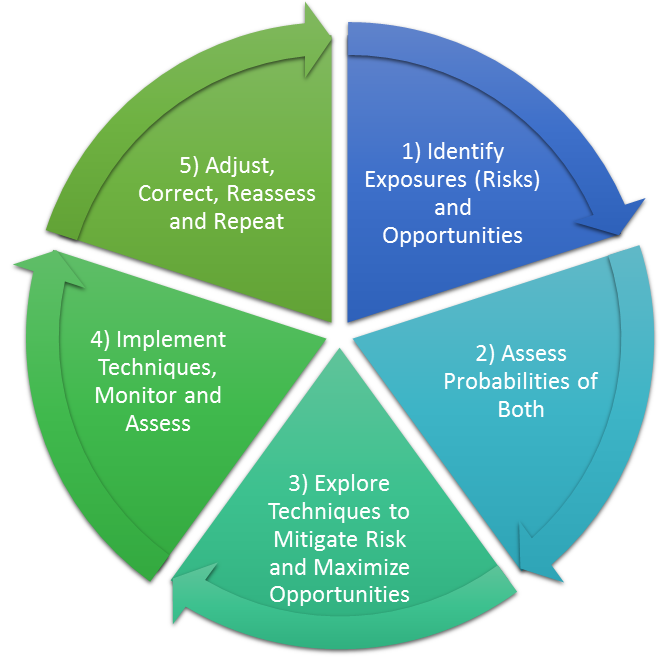 By following this structured approach you can easily see that risks and opportunities are two sides of the same coin and that tactics that manage risk also maximize sustainable benefits. The SRM process provides a new set of tools to generate effective sustainability strategies and tactics. The process involves the following steps:
- Identify exposure to loss (risks) and sustainable opportunities
- Assess probability, impact, benefits and costs of risks and opportunities
- Explore alternative techniques that manage risk and maximize sustainable opportunities and benefits
- Select the best combination of techniques
- Implement techniques
- Monitor, correct, reassess
Identifying risks and opportunities is fundamental to the SRM process. It is not a simple exercise; it requires a deep analysis and understanding of your organization to reveal the risks you face and the potential opportunities available to you. The more time you devote to this step the stronger your plans and tactics become. It is not “once and done”, it is continuous. As your operating environment changes so must your tactics.
The process enables you to identify and catalog your risks and opportunities. Risk managers have developed “risk registers” to document the top risks (along with background and details) the organization faces.
The SRM process includes risk registers as well as “opportunity manifests” where the organization’s most important opportunities are documented. The question is how do you uncover the top risks and opportunities? The SRM process includes several ways:
Create
1) Create a standing risk committee to lead to risk/opportunity identification. A charrette format is quite helpful. Risks and opportunities span the entire organization. The following experts should sit on the committee:
- CEO
- CFO
- Chief Risk Officer (or insurance advisor)
- General Consul (or attorney)
- Key internal stakeholders (department heads, front line employees, don’t forget building maintenance)
- Key external stakeholders (customers, suppliers, tenants, constituents, neighbors, government officials)
- Consultant
Review
2) The committee reviews several sets of information to identity risks/opportunities:
- Business or project plan
- Risks and opportunities already identified
- Organization and responsibility charts
- Strategies and tactics
- Organization culture and informal operating environment
- Financial history, current financial position, objectives
- Roster of physical assets
- Lists of all suppliers, customers and other stakeholders
- Material, service, sales, information flowcharts
- Risk history, including physical losses and legal/regulatory issues
- Market and competition
- Relevant external economic and social trends
Employ
3) The committee employs a variety of tools:
- Survey internal and external stakeholders
- Diagram systems, material flows, supply chains, construction and project plans. Look for interdependencies that create risks and opportunities. Be aware of how activity (for instance a physical loss) at any one part of the diagram can impact the entire process.
- Focused group brainstorming:
- Constructing scenarios (from simple to complex) that impact the organization. What new risks and opportunities are identified?
- Use a technique called “reminiscing about the future”. The team imagines that the organization has achieved the vision and then reminisces about how they got there (more on this in a latter blog).
- Consider emerging risks and opportunities, even unlikely events. How will these affect the organization?
- Push the green envelope with sustainable principles playing an even more prominent role in the strategy.
- Conduct a SWOT analysis (Strengths/weaknesses/opportunities/threats)
- Employ a variety of other tools including “mind maps”, “five whys”, “six hat thinking”.
The end products are the risk register and opportunity manifest. There is still work to be done. Risks and opportunities must be analyzed, assessed and prioritized. Plans to manage the risks and maximize the opportunities must be created. And of course, the strategy must be implemented and executed. But by completing the risk/opportunity identification process we are outfitted with the right equipment to begin our ascent up the slopes of Mt Sustainability.
Sustainability Risk Management Certificate Program

The Sustainability Risk Management (SRM) Certificate program with Stephen Bushnell is designed for professionals in the insurance, green building and sustainable business fields who want to learn about the important and changing landscape of green risk and enterprise risk management. The program provides a framework and strategy for identifying, evaluating and mitigating the challenges arising at the intersection of risk and sustainability.
Connect.
Find LEED consultants and professionals with green building skills and experience.
Meet Pros.


Learn.
Relevant education and training to consider.
News.


Why join Poplar Network?

- Learn about green building
- Save on LEED exam prep
- FREE continuing education
- Join the conversation
- Connect with peers