
Tree Trunk Saga: Understanding 10 Years of FSC vs. SFI


When it comes to green building, you’d think we could all just get along, right? Wrong. The bitter fight between SFI and FSC for the future of Certified Wood has waged for over a decade.

Wood is just about every builder’s best friend, whether it's residential or commercial, furniture or millwork... But we rarely stop to ponder that wood is a finite resource... a part of our ecosystem.
Only about 10% of the world's forests are "certified" in any way.
Because many forests are unmanaged or horrendously mismanaged, forest-focused non-profit organizations exist to "speak for the trees", as Dr. Seuss' Lorax would say.
In theory, such organizations work to promote an independent, open and transparent process that not only standardizes forestry (or relies on accepted standards), but also provides assessments of whether forests are being managed properly through an effective and accountable auditing system. Because wood is a renewable resource, responsible forest management is important to ensure that trees are available indefinitely.
However, there’s a bitter battle being waged over sustainable forestry and their standards.
Indeed, with the "green" products marketplace estimated to be worth $500 billion annually in the U.S., the Ten Years' War between the Sustainable Forestry Initiative (SFI) and the Forest Stewardship Council (FSC) over management and control of the world's "certified wood" is high stakes by all accounts.
Both organizations are tough, pelting each other, and sometimes their respective supporters, with allegations of hypocrisy, strongly worded letters, FTC complaints, commentaries on LinkedIn, and plenty of financial and political activity.
If this fight reads as familiar, it should.
SFI is a supporter of an organization known as The Green Building Initiative (GBI). The GBI was founded by Ward Hubbell, a lumber executive from Louisiana Pacific, who, for many years, oversaw a competitive rating system to LEED known as "Green Globes". Green Globes is a would be competitor to USGBC.
The forestry*, plastics and chemical industries in the U.S., which generate $200 billion, $400 billion and $800 billion dollars of domestic economic activity, respectively, are strong supporters of Green Globes and SFI.
In both battles, one organization or rating system seems to exist to highlight the important qualities, or lack of, in the other.
Forest Stewardship Council
FSC was founded in 1992 as an independent non-profit by a group of businesses, environmentalists and leaders from community, social and forest management groups.
The organization operates in over 80 countries and has developed a world-wide rating system that aims to ensure that wood products come from responsibly managed forests that provide environmental, social and economic benefits.
FSC offers two forms of certification: 1) Forest Management Certification and 2) Chain of Custody Certification. Both of these are subject to a third-party verification process managed by FSC Accredited Certification Bodies, or "Certifiers". The certifications are checked, or audited, for compliance by FSC on a regular basis.
FSC is governed by its Board of Directors who, in turn, are elected by the FSC General Assembly. The FSC Board is accountable to the FSC General Assembly, which consists of all FSC members, and convenes every 3 years (and met in 2014). All members join one of three groups within FSC: Economic, social or environmental, which are weighted to each hold 33.3% of the votes, respectively.
FSC operates off of a list of 10 guiding principles, and 57 criteria, that take into account a number of internal and external impact areas, such as ecological requirements, indigenous peoples, and additive composition.
Sustainable Forestry Initiative (SFI)
The Sustainable Forestry Initiative (SFI) is a North American standard originally set up by the American Forest & Paper Association as an "Code of Conduct", albeit industry friendly, for the U.S. forest products industry in the early 1990s.
Since that time SFI has evolved into a certification system with third-party verification and improved standards. Currently, more than 133 million acres of U.S. forests are enrolled in SFI.
Many LEED professionals and organizations (such as environmental group ForestEthics) believe that SFI is simply a "lobbying front" for the logging and paper industries in order to reduce the transparency and accountability of industry, in this case, forestry and paper.
Critics of SFI argue that with so much money at stake it is difficult (perhaps impossible) for an organization that polices its own Board member companies to be independent... Analogous to the "fox guarding the henhouse".
SFI has come under fire for a variety of sustainable forest management "sins" including seemingly unrestricted clear-cutting, and allowing certain chemicals to be used during the logging process.
Such actions have caused major companies to dump the SFI label from their products beginning in 2011, including HP, Allstate, Office Depot and AT&T, despite the fact that SFI has, as mentioned above, distanced itself from – most notably – the American Forest and Paper Association – and now utilizes accredited auditors.
Does FSC Allow Clear-Cutting?
Because there are a very broad range of forest management practices, the differences between FSC and SFI are many and complex. However, one topic that is a lightning rod is "clear cutting".
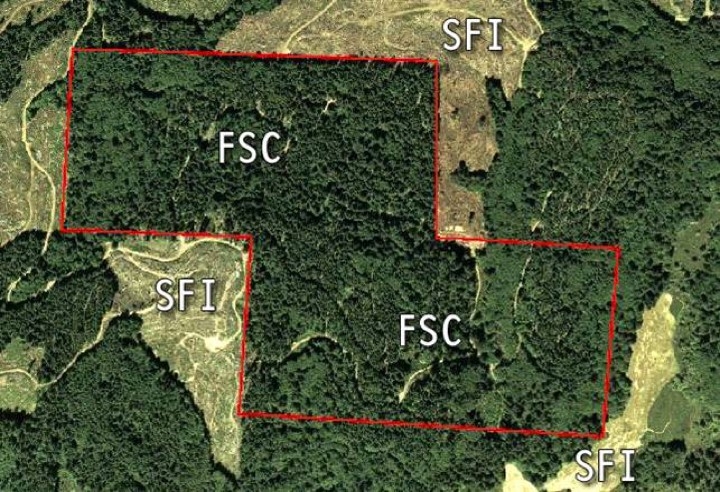
FSC and SFI both allow clear cutting.
According to Brad Kahn, Director of Communications at FSC, the goal of any forest management processes at FSC are to mirror natural forest processes. This involves weighing geographic factors, indigenous species habitat considerations, and the interests of the three (economic, social and environmental) groups that manage FSC, while aiming for less intense cutting and requiring much more retention (keeping trees), than would be required by law.
Some organizations do not agree with FSC that it should allow clear-cutting.
For instance, the Environmental Protection Information Center (EPIC), as reported by FSC-Watch, suggests that FSC's forest management practices have been "unraveling" due to the forest management certification of Green Diamond Resource Company, a logging company with a presence in the U.S. Pacific Coast, specifically, the Redwood Temperate Rainforest of Northern California.
Indeed, because the Northern California Redwood Forests are so iconic, it's hard to not react to the news that 8%, or 270,000 acres of the 5,100 square miles (3,264,000 acres) of Redwoods, the oldest and tallest trees in the world, could be clear cut.
The FSC Forest Management Certification of Green Diamond was overseen according to FSC's auditing standards and processes, which require an independent third party to conduct the verification. In the case of Green Diamond, the Certifier was SCS Global Services (SCS), which published a press release to announce the award.
All of this is legal in the U.S. Whether this is "OK" or not, is up for debate among environmentalists.
In terms of regulations and legitimacy of types of certification, FSC is still widely considered to be more stringent and robust than SFI, even if it's hard to measure the impact of each organization's policies in terms such as carbon.
To quote Paula Melton over at BuildingGreen, commenting on whether decisions can be made about carbon impact by simply choosing SFI or FSC products in her part 3 article on Wood Wars, "FSC wood is more likely to come from a less-intensively harvested forest that stores more carbon."
Whether it's Forest Management Certification or Chain of Custody, though, questions remain, about the thoroughness of FSC's auditing processes and whether they should be improved.
Late last year, the former Director General and Director of Policy Standards at FSC, Mr. Andre de Freitas, who is now Executive Director of Sustainable Agriculture Network, openly criticized the Chain of Custody certificate auditing process in a post on LinkedIn.
He highlighted the risk of "volume fraud", a flaw he believes exists in CoC auditing because FSC's system was never meant to address this type of fraud.
Suggestions for improvement mentioned in the post included using "volume reconciliation tools", updating the entire auditing approach and incorporating new technology to conduct the audits
LEED as a Battleground
LEED also does not penalize buildings for using non-FSC certified wood, such as that from SFI, it just does not award points for it.
While FSC is the only "Certified Wood" standard recognized by USGBC (as well as compliance with the Sustainable Agriculture Network Standard), greater levels of transparency clear-cutting in redwood forests and calls for improvement in the auditing standards of FSC by reputable professionals, should be addressed by FSC to avoid any perception of hypocrisy.
Not doing so can only embolden lobbying efforts by SFI and potentially foster sympathy among politicians who have little or no understanding of the implications of sustainable forestry, other than the importance to them of supporting American jobs.
----
(FSC/SFI forest map courtesy of Nadine Weil) "Heart of Green"
(Clearcut Forests by Sam Beebe via Flickr)
* Interesting factoid: According to the EPA, the U.S. forestry production industry is the leading generator and user of renewable energy.
LEED v4 takes green products to the next level.
Learn about how Environmental Product Declarations (EPD) and Life Cycle Analysis (LCA) affects your green building product marketing process in this FREE training course for Poplar members.
Connect.
Find LEED consultants and professionals with green building skills and experience.
Meet Pros.


Learn.
Relevant education and training to consider.
News.


Why join Poplar Network?

- Learn about green building
- Save on LEED exam prep
- FREE continuing education
- Join the conversation
- Connect with peers