
Is a Tankless Hot Water Heater Right for Your Home?


Thinking of going tankless? These are the questions - and answers - you need to know before switching your water heater.
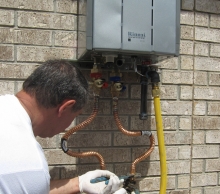
There are a number of high efficiency water heaters available on the market, but tankless water heaters, especially, seem to garner considerable curiosity. Unlike traditional water heaters, these nifty devices only heat water on demand, eliminating the need to heat standing water to have on supply. This has the potential to dramatically reduce a house’s hot water heating expenditures because water is only heated when needed. But while this is attractive to some, does it make tankless water heaters the best choice for every household? Not necessarily.
Above all else, the feasibility of a tankless system depends on the household’s typical hot water usage, and whether the intended system(s) will be utilized for the entire house or for only select systems. Also, as mentioned previously in this Q&A, natural gas fired or propane-fired tankless systems have different requirements than electric tankless systems. An electric tankless system may require adding sub-panels or increasing the amperage of your home because they require significant electricity to work effectively.
So, once you’ve determined how many hot water devices will need to be supported at any one time, add up their individual flow rates in gallons per minute. The sum is the desired flow rate that will need to be achieved by the tankless water heater.
It’s equally important to take into account the rate of temperature rise. So let’s do some more simple math: subtract the incoming water temperature from the desired output temperature. In other words, what change in water temperature will the heater need to achieve?
After answering these questions, it’s possible to determine whether or not a tankless water heater makes the most sense over other energy efficient alternatives - like solar heating systems or heat pump systems - for your home. If a tankless solution looks like a possibility for some or all of your water heating needs, congrats! According to the Office of Energy Efficiency and Renewable Energy, slight energy savings (8%-14%) can be found for houses that utilize approximately 86 gallons per day, and significant savings (24%-34%) for those that use less than 41 gallons per day. In dollars, they estimate that per ENERGY STAR tankless system, the average household saves at least $100 per year.
While the financial savings will unquestionably accrue over time, tankless systems are an expensive investment and the ROI will make take years to see. Consequently, the environmental impact likely needs to be a driving force for one to be overwhelmingly attracted to the this option. That said, as far as I can tell, saving the world one hot tank of water at a time is still an extraordinarily worthy goal.
Connect.
Find LEED consultants and professionals with green building skills and experience.
Meet Pros.


Learn.
Relevant education and training to consider.
News.


Why join Poplar Network?

- Learn about green building
- Save on LEED exam prep
- FREE continuing education
- Join the conversation
- Connect with peers