
Free Bike Programs Promote Health and Physical Activity


A 2014 study finds a decrease in heart disease and a reduction in depression among men and older riders in bicycle sharing programs.
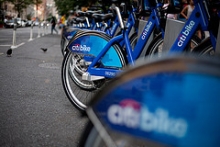
A bike share program is a public or public/private service that offers the public short-term bicycle rental from conveniently located stations. Bike share programs can be free, or paid.
The stations are typically unstaffed, automatic and open twenty-four hours per day. Bike shares developed in Europe during the latter part of the twentieth century. Vélos Jaunes, French for Yellow Bikes, was started in La Rochelle, France, in 1974, and is often credited with being the first successful bike share.
Yellow Bikes and other early bikeshare endeavors often struggled to overcome the frequency with which bicycles were stolen, damaged or returned significantly late. Free bike share programs seem to suffer from near universal theft and vandalism, leading proponents of such programs to require credit card deposits, and/or subscription based models, to deter abuse. In recent years, the GPS bicycle-tracking technology and mobile credit card payments have diminished these problems.
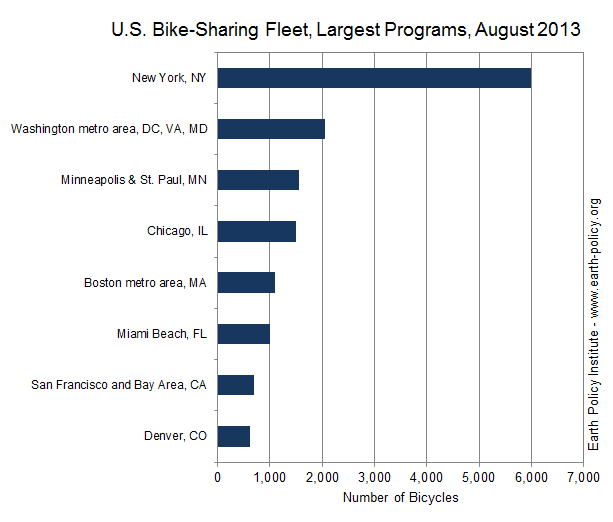
Having reduced these concerns, the number of bike share services worldwide has risen dramatically in recent years. As of spring 2013, over 500 cities spread throughout 49 countries were home to functioning systems.
Health Effects of Bikeshare Programs
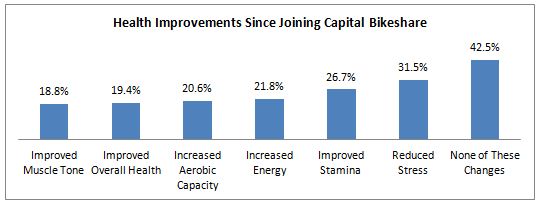
In cities with a thriving bike share service, the benefits are shared between users and non-users. In a study of members of Capital Bikeshare, a Washington D.C., Arlington and Alexandria, VA and Montgomery County, MD based bicycle sharing program, members were found to be generally more healthy than the population at large, and indicated that they experienced reduced stress, improved stamina, increased energy and increased aerobic capacity. 90% of respondents indicated that they had lost weight since joining Capital Bikeshare.
In another study, summarizing the health effects of London’s bike share system was published in the British Medical Journal in January 2014.
Researchers analyzed data including system usage, user surveys and city data regarding travel, physical activity, road traffic collisions and particulate air pollution. Researchers found significant health benefits, such as a decrease in heart disease and reduction of depression, among men and older riders, respectively, for example.
Although the health benefits stated above apply only to the riders of bikes in the program, many additional benefits are shared with the surrounding community. Bike share programs may diminish traffic and congestion, reduce air pollution, and decrease noise levels. The public may also enjoy a healthier local environment due to decreased community energy consumption and smarter local land use and development.
Bike Shares and LEED Neighborhood Development
The Leadership in Energy and Environmental Design (LEED) green building rating system considers the use of bicycle sharing programs to be beneficial to both green building occupants and urban planning projects.
LEED 2009’s Neighborhood Development (ND) rating system includes a credit called Bicycle Network and Storage. In LEED v4, the newest version of LEED, this credit has been renamed simply "Bicycle Facilities" and is worth 2 points.
The intent of this credit in LEED ND is to promote bicycling and transportation efficiency and reduce vehicle distance traveled, improve public health and recreational physical activity.
To achieve the credit for Bicycle Network, which is Option 2 (1 point), the LEED ND project must be designed such that at least 50% of dwelling units and nonresidential use entrances are located on an existing or planned bicycle network extending at least three continuous miles (4800 meters). Within those three miles (4800 meters), the network must connect to either a school, an employment center or at least 10 diverse uses.
Other rating systems, such as LEED BD+C may earn credit in the Location and Transportation (LT) category by incorporating access to a Bicycle Network.
While LEED v4 is the latest version of LEED, LEED 2009 projects remain by far the most numerous. In August 2012, the USGBC updated its catalog listing of LEED 2009 Neighborhood Development Innovation in Design credits. The document includes summaries of the organization’s decisions regarding awarding points in this credit category for bike share programs. In the document, the USGBC first acknowledges that a bike share system is a “transportation measure with notable environmental benefit.”
By reading further, one can begin to establish the characteristics a bike share system needs to receive points for the Innovation credit. Based on past rulings, bike shares must, at minimum, (1) satisfy the requirements of the Bicycle Facilities credit (see Neighborhood Development: Smart Location and Linkage), (2) charge, at most, a nominal membership fee, (3) justify the number of stations and bicycles provided and (4) provide and maintain the system for a minimum of three years.
Such policies, such as those by USGBC, promote bike share development and implementation, thereby encouraging both individuals and communities to share in their benefits worldwide.
----
References:
Information regarding the Neighborhood Development credit category and the LEED for Neighborhood Development Innovation in Design Credit Catalog was obtained from www.usgbc.org.
Larsen, Janet. “Bike-Sharing Programs Hit the Streets in Over 500 Cities Worldwide.” Earth-Policy.org. 25 April 2013. Available: http://www.earth-policy.org/plan_b_updates/2013/update112.
Midgley, Peter. "The role of smart bike-sharing systems in urban mobility." Journeys 2 (2009): 23-31.
Woodcock, James, et al. "Health effects of the London bicycle sharing system: health impact modelling study." BMJ: British Medical Journal 348 (2014).
Connect.
Find LEED consultants and professionals with green building skills and experience.
Meet Pros.


Learn.
Relevant education and training to consider.
News.


LEED CMP

Why join Poplar Network?

- Learn about green building
- Save on LEED exam prep
- FREE continuing education
- Join the conversation
- Connect with peers