
Could Farmbot Help Green Farmers Reduce Water Waste?


FarmVille comes to real life with this innovative, scalable technology. Could open source solutions like this change the future of green and sustainable farming solutions?

The Facebook-based FarmVille 2 from game maker Zynga sees roughly 40 million active users every month, according to 2013 data. Imagine if all those virtual farmers also had a real-life application for their green thumbs and business savvy? For Farmbot, that’s not as crazy an idea as it sounds.
The name alone is reason enough to raise your eyebrows, but the concept will really have you saying “wow.” First imagined back in 2011 by then-Cal Poly student Rory Aronson, the Farmbot is a completely open source, fully scalable solution that allows farmers of any size – from the WAHM with a small family garden to the commercial sized mass producer – to harness precision farming techniques.
What exactly is precision farming? Well, I’ll let the experts at NASA explain:
Imagine you are a farmer riding along in your 50,000-acre wheat field early in the growing season. You push a button on your tractor to turn on its Global Positioning System (GPS) monitor, which pinpoints your exact location to within one meter. Touching another button, you display a series of Geographical Information System (GIS) maps that show where the soil in your field is moist, where the soil eroded over the winter, and where there are factors within the soil that limit crop growth. Next, you upload remote sensing data, collected just yesterday, that shows where your budding new crop is already thriving and areas where it isn’t. You hit SEND to upload these data into an onboard machine that automatically regulates the application of fertilizer and pesticides—just the right amount and exactly where the chemicals are needed. You sit back and enjoy the ride, saving money as the machines do most of the work. Congratulations, you are among a new generation of growers called "precision farmers."
Now, when we think of farming, many of us have a difficult time balancing the mental imagery of a man in muddy overalls with a guy in a button-up sitting behind a tablet, but the reality is that in order for the world to overcome our growing food shortage, these types of technology solutions are utterly critical.
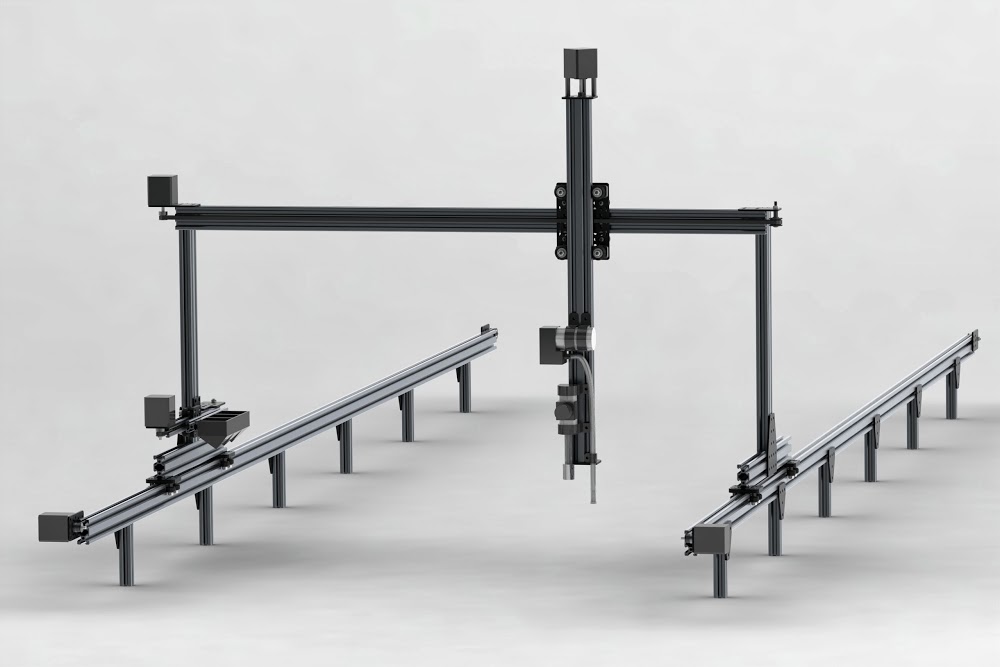
What Farmbot is doing, however, is omitting the requisite “50,000-acre what field” for maximizing on these techniques. Their open source solution provides anyone and everyone the instructions they need to make their own pulley and track system at a reasonable cost. Aronson told Wired last month that he hoped the prototype would ring in under $1,000.
But it won’t end with hardware that’s capable of watering, fertilizing and aerating your raised garden bed... Farmbot will also be supported with a gamified interface, developed by Aronson, and his extremely capable team, which includes the likes of Rick Carlin and Tim Evers, and their forum members.
Long story short, Farmbot is looking to marry resource-saving technology solutions with gamification for the everyday, small-scale farmer. To learn more about the nitty-gritty details, consider reading the 2013 white paper that started it all.
 Learn about how LEED addresses irrigation in the Water Efficient Landscaping credit (aka Outdoor Water Use Reduction in LEED v4). Experienced LEED consultant Alex Spilger guides you along the way as you complete this credit by working on an actual LEED project. You'll earn 1 Continuing Education Unit (CEU) in as little as 30 minutes.
Connect.
Find LEED consultants and professionals with green building skills and experience.
Meet Pros.


Learn.
Relevant education and training to consider.
News.


Why join Poplar Network?

- Learn about green building
- Save on LEED exam prep
- FREE continuing education
- Join the conversation
- Connect with peers