
The 7 Deadly Sins of Greenwashing


Greenwashing is the act of misleading consumers regarding the practices of a company or the environmental benefits of a product or service.
According to the UL 2010 Greenwashing Report (which is the most recent version), in that year there were 73% more products on the market that referred to themselves as "green" than existed the year before. Of those, only 4.5% of the 4744 products examined were completely free of greenwashing.
And, Greenpeace International reported in 2012 that greenwashing is alive and well in big business, providing case studies of the companies that spoke in reverent tones about the respect their executives had for the forests they are cutting down... Sad.
Perhaps this is because of the effects of climate change, or the growth of green building, the only segment of the real estate industry that has grown over the past few years, but the word sustainability is increasingly on our minds. Companies are increasingly using the word "green" and often banking on false information or vagueness to trick consumers into buying products that give the impression that the product is "eco-friendly" or “sustainable.”
Since there are few major standards or certifications for sustainable products, it is easy for companies to commit one or more of “the seven sins of greenwashing.”
1. Sin of the Hidden Tradeoff: This sin is committed by suggesting a product is “green” based on a very narrow set of attributes. For example, paper might come from a sustainably harvested forest, but might not take other environmental issues in the paper-making process into account. The Sustainable Forestry Initiative (SFI) is a common label on paper, but only accounts for how the trees were harvested. It does not reflect the distance the paper traveled, the loss of carbon sinks, etc related to the paper making process. In fact, according to a quote by Forest Ethics in an article in GreenBiz, the Sustainable Forestry Initiative has garnered a reputation for clear cutting forests.
2. Sin of No Proof: This is an environmental claim that cannot be substantiated by a third party or by easily accessible information. The supermarket chain known as Woolworths has been marketing their generic tissue brand claiming that “a certified environmentally managed company that is environmentally, socially, and economic responsible” produced the product. There is no information on the product supporting this claim.
3. Sin of Vagueness: When companies use terms that are poorly defined or very broad, the verbiage can mislead consumers. Tyson chicken is a culprit of this type of behavior. They label their chicken as “all natural” even though they are treated with antibiotics, fed GMO corn, and sourced from factory farms.
4. Sin of Irrelevance: Products will often display information that is unimportant or unhelpful in order to sway consumers into purchasing their products. CFCs, the most harmful ozone depleting substance, has been banned for decades, yet insecticides, lubricants, and disinfectants still label their products “CFC-Free” to greenwash potential customers. The label is completely irrelevant.
5. Sin of Lesser of Two Evils: Some companies will argue that their product is more environmentally sustainable than other products in the same category, but distracts from the general sustainability of the entire product category. Some tobacco farmers are growing organic in the hopes of attracting more customers. In fact, American Spirit’s “natural” smokes saw a 10% increase in sales per year for the last decade. These cigarette butts still litter the planet and cause cancer.
6. Sin of Fibbing: The worst sin, but luckily the least frequent are simply false claims. In Canada, two spa retailers, “EcoSmart Spas” and “Dynasty Spas,” were making false claims that their products met the criteria of the ENERGY STAR Program. The companies were slapped with a fine for brazen greenwashing.
7. Sin of Worshiping False Labels: Some products allude to a third party endorsement where no such endorsement exists. Companies like Organix, Beauty Pure and Simple, name their product line to give the allure of a toxic free, green material. There is no third party endorsing the product, Organix does in fact include a long list of toxic ingredients.
As the green and sustainable trend grows, consumers are becoming more willing to pay for “organic” and “all-natural” products. Manufacturers have noticed this trend and are striving to increase their profit without actually investing in producing sustainable products.
To avoid greenwashing, remember “the seven sins” and read the labels.
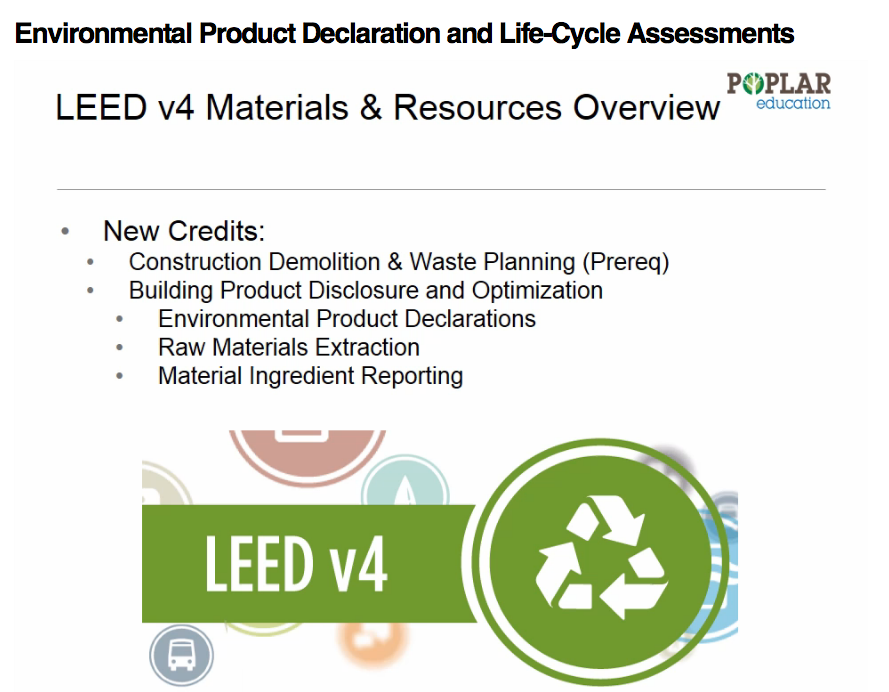
LEED v4 takes green products to the next level.
Learn about how Environmental Product Declarations (EPD) and Life Cycle Analysis (LCA) affects your green building product marketing process in this FREE training course for Poplar members.
Connect.
Find LEED consultants and professionals with green building skills and experience.
Meet Pros.


Learn.
Relevant education and training to consider.
News.


_itok-GdAYtPyq.JPG)

Why join Poplar Network?

- Learn about green building
- Save on LEED exam prep
- FREE continuing education
- Join the conversation
- Connect with peers