
3 Changes to Green Power in LEED v4


LEED v4's Green Power and Carbon Offsets credit incorporates three changes from LEED 2009. Here’s what you need to know.
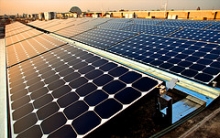
Among the more significant changes in the shift from LEED v2009 to v4 are the credit requirements around renewable energy.
Particularly, the Green Power and Carbon Offsets credit (formerly Green Power) includes a number of changes that were brought about during the six public comment periods.
The intent of the Green Power and Carbon Offsets credit in LEED v4 is to encourage the reduction of greenhouse gas emissions through the use of grid-source, renewable energy technologies and carbon mitigation projects.
The requirements for meeting the new credit include engaging in a contract for qualified renewable energy resources, for a minimum of 5 years, that must cover either 50% or 100% of the project's energy through one, or a combination of, green power, carbon offsets or renewable energy certificates (RECs).
Below are the major adjustments that you’ll need to be cognizant of in order to accrue 1 or 2 points in LEED v4.
1. Total Energy Usage vs. Electricity Only
In LEED v2009, it was enough to offset the projects electricity usage. Not anymore! In v4, projects must demonstrate an offset of at least 50% (to 100%) of total energy usage (both electricity and non-electricity energy).
To calculate the project's annual energy consumption, the project team must use either the calculation from EA Prerequisite Minimum Energy Performance, if Option 1 (whole building energy simulation through energy modeling) was performed, or use the U.S. Department of Energy's Commercial Buildings Energy Consumption Survey (CBECS) database to estimate total energy use.
All projects must now convert their annual non-electricity energy use to metric tons of CO2, equivalent CO2e... To do so requires using the default emissions factors established by ENERGY STAR Portfolio Manager. You can learn more about how ENERGY STAR Portfolio Manager calculates greenhouse gas (GHG) emissions here.
2. Carbon Offsets
Previously, renewable energy credits (RECs) were the required method of offsetting electricity usage. Now, however, electricity and non-electric energy are required to be offset through a choice of green power, RECs and carbon offsets through verified emissions reductions (VERs) credits to account for actual offsets of energy usage (fuel oil, steam, natural gas, etc.) All carbon offsets must be Green-e Certified, or the equivalent, by following the standards put in place by Green-e.
Under Green-e, credits for offsets are issued by various established organizations, such as the Gold Standard, to registered projects for verified emissions reductions, in units of metric tons of carbon dioxide-equivalent (CO2e). The credits, referred to as Verified Carbon Units (VCUs), Verified Emissions Reductions (VERs), Climate Reserve Tonnes (CRTs), or Emission Reduction Tonnes (ERTs), are assigned unique serial numbers and tracked, transferred, and retired in electronic registry systems maintained by the project certifiers.
Such carbon offsets may now be used to mitigate Scope 1 or Scope 2 emissions on a metric tonne of carbon-dioxide equivalent bases. Scope 1 emissions are greenhouse gases that are emitted directly from the building itself (i.e. from fossil fuels burned on site) through a gas or oil fired furnace, or other locally fueled energy source. Scope 2 emissions are those that come from purchased electricity, high temperature hot water, chilled water or steam power, that is sourced by a utility, and includes transmission losses.
To find Green-e Certified renewable energy or carbon offset products, visit Green-e here.
3. Time Commitment
Per LEED v4, the minimum commitment to green power is now five years, versus a two year period in v2009, and the qualified renewable resources must be delivered at least annually, if not more frequently. The verified generation source must have come online after January 1, 2005.
Extra Benefit for Net Zero
The Green Power and Carbon Offsets credit becomes easier (and less expensive) to achieve if the LEED project is also incorporating on site renewable energy such as small wind or solar photovoltaics, which may be eligible for the Renewable Energy Production credit in LEED v4).
Buildings that qualify as Net Zero, or those that consume zero net energy on an annual basis, can earn 2 points under this credit without purchasing any additional renewable energy, RECs or carbon offsets. However, to do so, if the Net Zero project achieves zero net energy through on-site renewable energy, it must not sell any of the energy as RECs on the open market. Learn more about Net Zero here.
By successfully engaging in a contract for green power and/or carbon offsets equal to 50% of the project's total energy, the project can earn 1 point. 2 points can be earned if the project contracts for 100% of its energy.
 Learn about how LEED addresses energy modeling to maximize energy efficiency in commercial buildings in the "Optimize Energy Performance" prerequisite and credit which is relevant to every LEED rating system. You'll Earn 2 Continuing Education Units (CEUs) in as little as 1 hour. Only $29.95!
Connect.
Find LEED consultants and professionals with green building skills and experience.
Meet Pros.


Learn.
Relevant education and training to consider.
News.


Why join Poplar Network?

- Learn about green building
- Save on LEED exam prep
- FREE continuing education
- Join the conversation
- Connect with peers