
What's the Difference Between Preconsumer and Postconsumer Recycled Content?


Multiple MR credits center around recycled content as a means for improving the total impact of construction. Do you understand the key LEED terms involved for compliance? Figure them out here.
Recycled content is a key component of many LEED projects, whether NC or EB, so understanding the vocabulary surrounding this pillar is essential. There are two key terms: preconsumer and postconsumer.
Preconsumer content (which was also referred to as “post-industrial content” prior to LEED v4) is the product of process waste. Simply put, it’s the percentage of materials in a product that are recycled from sourced manufacturing waste, and can include sawdust, planer shavings, bagasse, culls, walnut shells, trimmed materials, over issue publications and obsolete inventories, among other sources. (It’s important to note, however, that scrap items capable of being reclaimed within the same process cannot be included within this category.)
Postconsumer material, on the other hand, is the waste generated by households or commercial, industrial and institutional facilities in their role as end-users of the product. In other words, it’s the end waste that cannot be used again for the initially intended purpose but can be recycled into a new product (i.e., aluminum, glass, plastic and paper).
In exemplifying the difference, LEED v4 cites the following:
“For example, a power plant’s end product is electricity, so waste productions from the combustion of coal may be considered preconsumer waste but not postconsumer; the power plant is not an end-use consumer of the coal.”
In regard to LEED crediting, preconsumer materials are not weighted as heavily as postconsumer materials are. Consider Equation 2 from the MR Building Product Disclosure and Optimization – Sourcing of Raw Materials section of the LEED v4 guide:
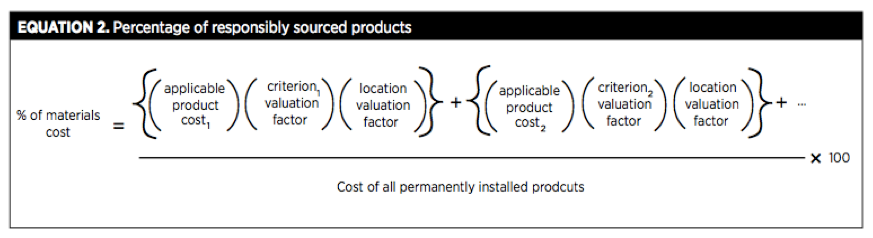
Wherein the criterion valuation factor of postconsumer recycled materials is 1.0, by cost, and preconsumer recycled materials is 0.5, also by cost. Location valuation factor is found in MR Overview, Location Valuation Factor.
So, naturally, if you have two material options each with the same costs, it would make the most sense to credit calculation to opt for the one with higher postconsumer recycled content. (This makes sense given that the material would be more likely to transfer into waste since it’s already at it’s end-user.)
Remember that you may need the following items as supporting documentation for your calculation:
- Product and manufacturer names, costs, percentage of post-consumer and pre-consumer (post-industrial) content.
- Corporate sustainability reports, cutsheets, or manufacturer’s letters that document the listed products’ recycle content
- A list of actual materials costs, excluding labor and equipment for CSI Division 03-10, 31 (Section 31.60.00 Foundations) and 32 (Sections 32.10.00 Paving, 32.30.00 Site Improvement, and 32.90.00 Planting) only; including Division 12 is optional.
Likewise, note that furnishings and furniture (CSI Division 12 components) need to be included or excluded consistently across all MR Credits. The credit applies mostly to CSI Master Format 2004 Edition Divisions 03-10, 31, and 32.
Finally, because the high-dollar value of mechanical, electrical and plumbing appliances, components and equipment would dramatically skew your calculation, these items should not be incorporated in the calculations for this credit.
Connect.
Find LEED consultants and professionals with green building skills and experience.
Meet Pros.


Learn.
Relevant education and training to consider.

Q&A.


Why join Poplar Network?

- Learn about green building
- Save on LEED exam prep
- FREE continuing education
- Join the conversation
- Connect with peers