
Tiny Living...Environmentally Friendly Housing from Parking Spots?


Earlier this month, something rather extraordinary was unveiled in a parking garage of all places. Hint: it involves recycling and efficient design – two things all LEED professionals love!
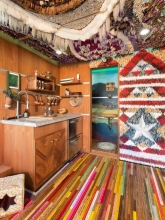
Tiny houses are micro-sized homes that are built totally from scratch using kits or from existing small structures such as cargo containers or sheds. Some tiny houses even work with trailers that haul them around right behind your vehicle, offering the best of both worlds - a real looking home and unlimited mobility. What we don’t typically consider – at least I don’t – are tiny houses that are made from much larger structures. After all, it sounds like quite the juxtaposition... Is it a tiny house? Or just a tiny apartment? Does it matter?
These questions are exactly what some students from the Savannah College of Art and Design have raised in their process of redesigning some otherwise abandoned, unused parking garages.
Rethinking Empty Parking Garages
There are quite literally millions of empty parking spaces throughout the country... Yet in some urban areas hit hard by the recession or by shifts in demographics away from cars to public transportation, parking garages can lay fallow. Like any abandoned structure, the question becomes what to do with the properties if the demand for their original purpose is no longer there.
So when a group of 75 Savannah College of Art and Design (SCAD) students from 12 different academic programs and more than four dozen faculty and alumni looked to tackle this very problem, they sought out a creative, scalable solution. Their idea? Turn obsolete parking garages into tiny havens that are literally the size of a parking space (8 feet wide by 16 feet long).
As you can see in the above video, the results are truly beautiful. Similar to the concept of plug and play housing, the diverse team developed and implemented three individual designs, each embodying one of three different continents – North America, Asia, and Europe. From floors made from recycled rulers to 1,000 worm compost bins, these sustainable units are every bit as practical as inspirational.
Since the April 9th unveiling of the SCADpads, students have actually moved into the tiny houses to begin truly testing their product. Be sure to follow along to on the SCAD blog to receive updates on their experiences. Something tells me the posts will be worth the read!
 In 2008, a used house in the U.S. averaged $244,000. That is far more than the average American can afford. Tumbleweed's book shatters the myth that affordable housing needs to be cheap. You'll learn ... more info.
Connect.
Find LEED consultants and professionals with green building skills and experience.
Meet Pros.


Learn.
Relevant education and training to consider.
News.


Why join Poplar Network?

- Learn about green building
- Save on LEED exam prep
- Gain continuing education
- Join the conversation
- Connect with peers