
Juicebox is Much Needed Refreshment for Solar Homes


Solar power in the U.S. is becoming an increasingly viable option for small building projects thanks to innovative solar energy storage companies like JuiceBox.
According to a recent Solar Energy Industries Association (SEIA)/GTM Research report, in the first half of 2014, more than a half million U.S. homeowners and commercial customers installed solar photovoltaics (PV).
Such growth is truly remarkable, and the report forecasts that PV installations will reach 6.5 GW (direct current) in 2014, up 36% over 2013, which is more than three times the market size of just three years ago.
The Potential for Batteries
The market for solar PV is helped by continued innovations in complimentary clean energy technologies, such as giant batteries that can store unused power.
As has been reported with companies such as Tumalow and Acquion, renewable energy storage through building-sized "smart batteries" could allow properties to store energy produced on-site by renewables, such as solar or wind, and use that energy whenever it's needed most.
By drawing on their self-generated power during peak hours, buildings could save significantly compared to the cost of peak hour utility produced energy. Energy storage products have the double benefit of reducing stress on the grid, by smoothing out intermittent spikes in energy use, while also allowing building owners to cut energy costs... So utilities should be breathing a sigh of relief that they don't have to build new capacity, right?
That's not happening. There were even reports from a year ago of California energy companies taking the unprecedented step of going to war with their own customers over the growth in the demand for residential solar power storage and net metering.
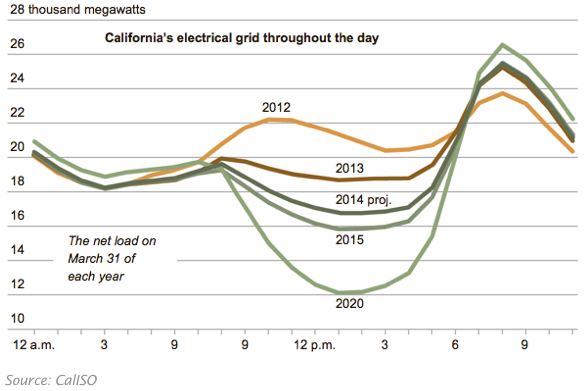
Lately utilities are fearing the worst and have been crying "fowl" over what the clean energy community is referring to as the "duck chart" (seen below).
Utilities claim that if the duck shaped curve becomes reality, they will have major technical problems ramping up the demand for energy late in the day as solar power wanes in the evening, and they are using this argument in their fight against solar and other renewables.
However, the potential for on-site battery storage is just one (of the many) counter arguments that help us portray duck chart fear mongers as the quacks they are.
Energy Storage Market Improving
From a bird’s eye view of the ever-pressing challenges associated with the grid’s infrastructure and efficacy, peak shaving and personal energy production/storage are overdue solutions, and technology is starting to catch up to the market potential.
Unfortunately, the technology is still immature enough (and costs prohibitively high) that the average homeowner or small business has had few options in terms of on-site energy storage.
However, costs of giant batteries are dropping.
Last year, Bloomberg reported that the average battery cost is expected to fall 57 percent by 2020, dropping the price from $1,893 per kilowatt hour of storage to $807. And Tesla founder Elon Musk was recently quoted as saying that he'll be "disappointed" if it took 10 years for his company to produce a $100 per kilowatt battery pack, suggesting that it could happen by 2020.
Price drops are good news for the energy storage market, as is the fact that solar power storage systems are eligible for the Federal Renewable Energy Tax Credit through 2016.
What's even more compelling is the potential for advancements in smart systems that use algorithms to manage the delivery of stored energy whenever and wherever it's most needed.
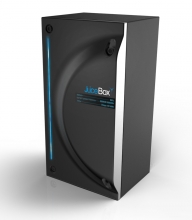
 Enter: The Juicebox
A Silicon Valley based green building startup is focused on building the world's most efficient high-voltage lithium-ion energy storage for renewable energy.
The "JuiceBox" as it's called is not just dumb storage, but is designed to deliver an intelligent, maintenance free energy management solution. By leveraging advances in lithium-ion technology, the 8.6 kWh system is designed to operate in either grid-supported or off-grid systems, and includes a smart controller that inherently adapts to maximize peak shaving opportunities.
JuiceBox CEO Neil Maguire stated, "Energy storage tied to solar solves a number of difficult challenges on the grid but it must be safe, intelligent, controllable and flexible to meet a variety of local needs and adapt to changing utility standards."
Each unit incorporates smart internal sensors allowing the JuiceBox to continuously monitor for problematic anomalies (i.e., fault handling and fail-safe behavior).
"Safety, reliability and long life are all key performance metrics for our advanced energy storage systems" said Greg Maguire, VP Operations. "JuiceBox engineers have a background in automotive quality and reliability, lithium-ion cathode manufacturing and cell testing, and battery management system electronics and semiconductor manufacturing. We expect the energy storage regulatory environment to tighten and our systems will be be at the forefront of those requirements."
The company's founders recognize that energy production is becoming personal in nature and with better and better access to information, utility customers may increasingly be asking themselves questions about power, like... "Who produces it?" "How clean is it?" "Where does it come from?" "Is my energy consumption causing problems elsewhere?"
While pricing has not been made available yet, the JuiceBox is expected to be released in early 2015.
To learn more about the Juicebox, visit their site.
LEED and Energy Storage Products
It's not hard to imagine what could happen in the future when an energy model, say used to earn the Optimize Energy Performance credit within LEED, is somehow tied to the actual building performance over time and connected to a smart energy storage product, such as the JuiceBox.
Since, LEED measures (and awards) building design based on a reduction in energy COST, not just energy USAGE, a product that stores renewable energy for later use could help buildings earn significantly more points by maximizing energy cost savings.
(If you're preparing for the LEED v4 AP BD+C exam, and want to learn more about how LEED projects are awarded points based on energy cost reduction, you can choose the Energy Modeling credit with the GreenStep exam study guide with Project Experience to learn more about the LEED EA Optimize Energy Performance credit).
Connect.
Find LEED consultants and professionals with green building skills and experience.
Meet Pros.


Learn.
Relevant education and training to consider.
News.

Q&A.


Free Tools

Why join Poplar Network?

- Learn about green building
- Save on LEED exam prep
- FREE continuing education
- Join the conversation
- Connect with peers