
Green Homes Worth More: 5 Factors with Financial Benefits


Green homes, those that have been retrofitted or designed for maximum efficiency and occupant health, offer many financial benefits.

Green doesn't just mean great for the environment, it can also be synonymous with turning many American families' most significant investment into a more powerful asset. Now, with the housing market picking up, many builders are insisting on incorporating green building strategies into their efforts because of the incremental value and growing appeal of green homes.
Here are five reasons why green homes are worth more than non-green homes.
1) Trend Toward Smaller Homes:
A NAHB study indicates that smaller homes are becoming more attractive to many people because of their greater managability and the typically accompanying smaller mortgages.
While in the 1950s, the average American home was approximately 943 square feet, today it is 2,438 square feet. The study indicates that most builders agree that homes in the future will not only be smaller, but also more appropriately designed to practically fit our lifestyles.
Builders surveyed expect homes to average 2,152 square feet in 2015, 10% smaller than the average size of single-family homes started in the first three quarters of 2010. To save on square footage, the living room is high on the endangered list – 52 percent of builders expect it to be merged with other spaces in the home by 2015 and 30 percent said it will vanish entirely.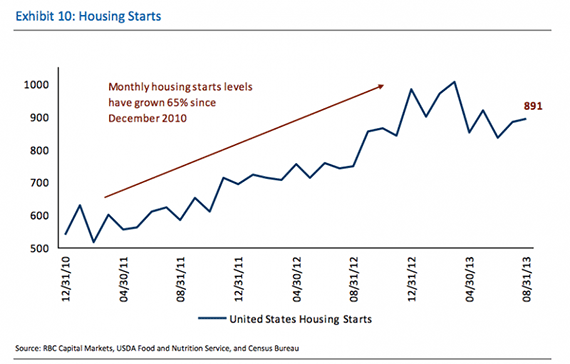
2) Perception of Higher Quality:
According to a 2012 study by McGraw-Hill both new home buyers and homebuilders and remodelers who build green perceive green building to be higher quality than conventional building. Indeed, 90% of builders regard higher quality as a key factor for their choice of building green, or investing in green training.
The report notes that consumers are increasingly value-driven... around two-thirds of builders and remodeler respondents state that customers request green homes or remodeling projects in order to lower their energy use or save money. This recommendation is more than twice as frequent as any other factor.
3) Lower Operating Costs:
Consistent with the trend toward smaller, higher quality homes, buyers increasingly recognize that green homes have lower bills due to higher building performance. As energy costs increase, every incremental dollar of heating oil, propane, natural gas, or electricity that we use to heat, cool, light or condition our homes unnecessarily is money lost forever.
Green homes have well-insulated ceilings, walls and energy efficient lighting. Factors such as weatherstripping, energy efficient light bulbs (LEDs or high-efficiency fluorescents), vampire loads, efficient thermostats, high-efficiency water heaters and HVAC systems, and low-flow water fixtures can add up to as much as $2,000 in savings per year.
Of course, the “greenness” of a home can vary drastically in terms of its ability to reduce costs or, yes, produce a profit. Thanks to federal and state incentives for renewable energy or energy efficiency improvements, some markets (such as my home state of Connecticut) where the cost per kWh is very high, installing solar photovoltaics on your home can actually put money in your pocket.
4) Green Certified Homes May Sell Faster:
While the data is somewhat inconsistent across various markets and green rating systems, green homes that are certified as such may sell faster than non-certified homes. A May 2009 study titled Certified Home Performance: Assessing the Market Impacts of Third Party Certification on Residential Properties by Ann Griffin at the Earth Advantage Institute, Ben Kaufman of Green Works Realty and Sterling Hamilton of Hamilton Investments, LLC, found that in In the Portland metro market, not including Clark County, WA, new and existing homes stayed on the market for an average of 73 days. New homes in the same area stayed on the market for an average of 99 days. Sustainable new homes in the same market sold one-third faster, staying on the market for an average of 66 days.
The report continued that the Northwest MLS reported similarly positive results in tracking certified home sales data. Sustainably certified homes (or E-Cert homes) built in 2007 accounted for 16.7% of the single-family homes and 18.7% of the condominium sales in King County in the 9- month period ending May 31, 2008 (Green Works, 2008).
NWMLS data shows that new construction E-Cert single-family homes sold in 18% less time, sold for 4% more, and were 25% smaller than noncertified homes. Priced per square foot, E-Cert homes were 37% more valuable. New construction E-Cert condominiums sold for 3% more and were 20% smaller than noncertified new construction condos. Priced per square foot, E-Cert condos were 28% more valuable than noncertified condos.
5) Certified Green Homes Premium:
The Earth Advantage study found that green certified homes in the Seattle metro area sold at a price premium of 9.6% when compared to noncertified counterparts, based on a sample of 68 certified homes. In the Portland metro area, certified homes sold at a price premium ranging between 3% and 5%. In addition, the certified homes stayed on the market for 18 days less than noncertified homes. These results are based on a sample of 92 certified homes and comparable properties approved by a project appraiser.
A similar study, done in 2012 by researchers at UC Berkeley and UCLA examined homes that were labeled by LEED, GreenPoint Rated and ENERGY STAR and found that these homes sold for a premium of 9% over comparable non-green certified homes. The team, led by Nils Kok, a visiting professor at UC Berkeley, evaluated data from 1.6 million homes sold in California from 2007-2012. Based on the average California home price of $400,000, the green labels increased the value of the homes by $34,800.
Connect.
Find LEED consultants and professionals with green building skills and experience.
Meet Pros.


Learn.
Relevant education and training to consider.
News.


Q&A.


Why join Poplar Network?

- Learn about green building
- Save on LEED exam prep
- Gain continuing education
- Join the conversation
- Connect with peers