
The Hidden Potential of Google Plus


Up until our recent launch of Poplar, I thought a lot about Google "Plus", the search giant's social networking tool.
Google is incorporating Google+ into almost everything. As an online marketer, I was particularly intrigued by a search engine optimization tactic to incorporate the use of rel=author tags (which associates an author with their Google+ profile) into our member profiles. When Poplar members write published articles for LEED continuing education, we wanted them to benefit from increased visibility in search engine results pages (SERPs).
As I was playing around with it, I found myself thinking about the potential for Google+ when compared to Facebook, Twitter and other social media tools in terms of total "users".
While I don't believe Google+ will replace Facebook, per se, I've believe Google+ has the potential to destroy Facebook in terms of total users, in the next couple of years.
Indeed, Google+ could be to Facebook what Microsoft's Internet Explorer (IE) was to Netscape Navigator in the browser wars.
The Potential of Google+
You might say, "There's simply no potential way in hell that could happen. I use Facebook, along with about 1 billion other people as well. I've never even heard of Google+!"
And you might be right. But essentially we'd be disagreeing about a single word: Potential. I see the potential, you don't, and maybe we agree to disagree. The potential is there, it's invisible, and you may not be aware of it, but it's powerful nonetheless. Indeed, according to NASA, the sun produces 10,000 times the Earths entire energy needs in approximately 1 second. But most of us are not motivated by this amazing power, and we may not even consider this huge potential until we are sitting in our dermatologist's office while she stares somberly at a mole. Potential is hidden literally everywhere! To use another example, even though we don't see it, it's the difference in electrical potential between the clouds and the ground that causes lightning to strike. Lightning is rare because only a truly massive amount of electrical potential is enough to create a pathway through the air to the ground. Air is a very poor conductor.
In electrical science, we can examine a lightening strike with a simple formula called Ohm's Law. Ohm's Law looks like this:
I=V/R
(I) equals current, or the amount of work that can be done when a circuit is open. (V) equals electrical potential, actually the difference in potential, between two points (the positive and negative on a battery, for instance), and is measured in volts. (R) equals resistance.
In our lightning example, the air is the resistance, and it takes an incredible amount of electrical potential to create a current that goes from the clouds (positive) to the ground (negative).
Google+ and Ohm's Law
So what does all this have to do with social networking, you ask? I've got a simple analogy.
Google as a company has significant (almost incomparable) potential in that its numerous, networked products, from search to Gmail, to Android on mobile phones, to self-driving cars, are literally everywhere. So, it's high voltage "potential", so to speak.
We, the people, are the "current" or the future work to be done. Consider that Google already enjoys the production of countless websites building content 24/7/365 so that Google can serve ads against the content in its search results pages (SERPs). So, in some way, we already ARE the work in real life!
The "resistance" is limited only to the number of Google's products we encounter and use. I personally use search, Gmail, Google Docs, and many other Google products including Google+. But with Google+, I started using it almost by accident because it is integrated into Gmail and now, as I mentioned above, it is integrated with search results too.
So, much like how Microsoft "won" the browser wars by integrating IE into the Windows operating system, Google will incorporate Google+ into everything it does, from cars to wearable computing, until it "wins" by getting people to use it even more frequently than they use Facebook, whether they realize they're using it or not.
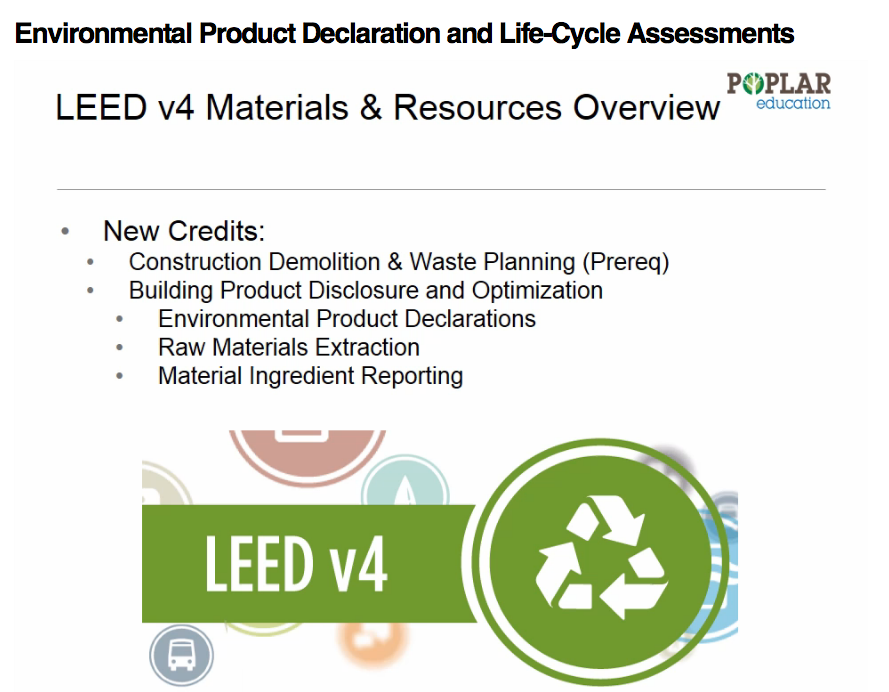
LEED v4 takes green products to the next level.
Learn about how Environmental Product Declarations (EPD) and Life Cycle Analysis (LCA) affects your green building product marketing process in this FREE training course for Poplar members.
Connect.
Find LEED consultants and professionals with green building skills and experience.
Meet Pros.


Learn.
Relevant education and training to consider.
News.


_itok-GdAYtPyq.JPG)

Why join Poplar Network?
- Learn about green building
- Save on LEED exam prep
- FREE continuing education
- Join the conversation
- Connect with peers