
Design and Construction as a Solution to Overconsumption


Education and creation of general awareness of climate change is fundamental to redirecting the path that architecture is following.

Throughout history, humans have adopted different approaches to the environment, altering it to our own interests. However, what is clear is that the conservationist viewpoint, which advocates and promotes a traditional use of natural resources in the manner of primitive societies, is currently outdated.
As human beings, we are part of a global ecosystem (the world of nature) that is subject to certain laws, so our built environment is embedded in the tissue of natural processes. It is a fact: we live in and with nature, which does not mean to deny all the scientific and technological advances discovered with time. It is a matter of balance and context.
I strongly support the use of technologies in a proper way. Having an empathetic attitude towards the environment is definitely a useful tool when designing and constructing. Having a wide knowledge of history and a deep concern for ecological principles is fundamental to understanding the aforementioned natural laws and to changing our course to a sustainable one.
Architecture and Sustainability
The aim of this article is to argue my opinion with regard to the role played nowadays by architecture and its overconsumption of energy and natural resources; framing this fact in a political perspective, considering historical approaches and different forces with their arguments in favor and against the problems exposed.
Currently there is a great diversity in practices of sustainable architecture and a plurality of interesting discourses, so that, the challenge of sustainability is more a matter of local interpretation than of the setting of objective or universal goals.
Environmental degradation is a fact, and is manifested in many different forms: global warming and climate change (ozone depletion), excessive population growth due to economic growth, and technological choices, which have positive as well as negative aspects.
The present situation is critical, though it does not seem to be...
Maybe the consequences will not be immediate -and that is why it is so complex and difficult to solve- but a point of no return will be reached if nothing changes. This is the main reason why the education and creation of a general awareness about these issues is fundamental to redirecting the path that architecture is following, but this is another topic that will not be discussed in this article.
As an architect, I am aware that buildings and designs are the legacy for future generations. It is a major burden I cannot ignore without pondering on the kind of architecture that is being left for posterity.
Buildings consume energy and resources and generate waste. They are responsible for approximately 50% of CO2 emissions(1), and the other half comes from the current pace of life we have, that is to say, from the way cities, buildings and houses are designed, as that influences and determines how people move through the city, what and where people eat, schedules and almost every single action in our lives.
In other words, from an extremist point of view, the repercussion of architects' actions (urban planning, interior design, building design, etc.) is huge, not only on the way we live, but on the environment and, ultimately, on the future of the Earth.
The Politics of Overconsumption of Natural Resources
The present over-consumption of energy and natural resources is, from my point of view, the most disturbing point in this topic.
Greenhouse gas emissions are rising because of the increasing global energy use. Furthermore, the majority of the population is unaware or unconcerned about their complicity and contribution to the issue. There are other priorities that guide us when consuming and shopping, such as low prices and familiarity of products.
This is exactly what happens with fossil fuels, which provokes mitigation against the switch to renewable energy sources.
As a result, if there is no consumption, there is no investment either, so development stops and the vicious circle continues. This is a complex problem to face because it is not only about changing people habits, but their mentality.
Some parties and organizations have actively confronted this issue. The United Nations (UN) can be considered one of the most influential nowadays, implementing a plan named Agenda 21. It is a non-binding, voluntarily implemented action plan with regard to sustainable development; product of the Earth Summit (UN Conference on Environment and Development) held in Rio de Janeiro, Brazil, in 1992. It is an action agenda for the UN, other multilateral organizations, and individual governments around the world that can be executed at local, national, and global levels. The plan has been affirmed and modified at subsequent UN conferences.
The United States is a signatory country to Agenda 21, but because Agenda 21 is a legally non-binding statement of intent and not a treaty, the United States Senate was not required to hold a formal debate or vote on it. It is therefore not considered to be law.
Over 528 cities in the U.S. are members of ICLEI, an international sustainability organization that helps to implement the Agenda 21 and Local Agenda 21 concepts across the world... Nevertheless, during the last decade, opposition to Agenda 21 has increased within the country at the local, state, and federal levels.
The Republican National Committee has adopted a resolution opposing Agenda 21, and the Republican Party platform stated that the Agenda 21 is erosive of American sovereignty. Several state and local governments have considered or passed motions and legislation opposing Agenda 21.
Brown Agenda vs. Green Agenda
As a result of the Increasing debate on issues of urban sustainability, the consolidation of environmental agendas and the definition of a specific body of problems and policy issues have been established on two levels.
The first one involves green agenda problems occupying the concerns in the developed nations such as global warming, ozone-layer depletion, loss of bio-diversity, deforestation, and the exhaustion of non-renewable resources.
However, for the developing world, these global environmental problems are less immediate than the need to resolve acute problems relating to poverty and the so-called brown agenda problems.
A renewed challenge to the planning and management of cities is presented in the brown agenda, which is concerned with social and physical urban environmental problems mainly associated with poverty; problems of air and water pollution, inadequate waste management, the lack of basic services and green areas, declining infrastructure, and poor housing conditions, as well as issues of health, crime, violence, and social exclusion.
It is now a commonly held belief that the green agenda cannot be addressed until the urgent problems of urban social deprivation and inequalities are resolved. (2)
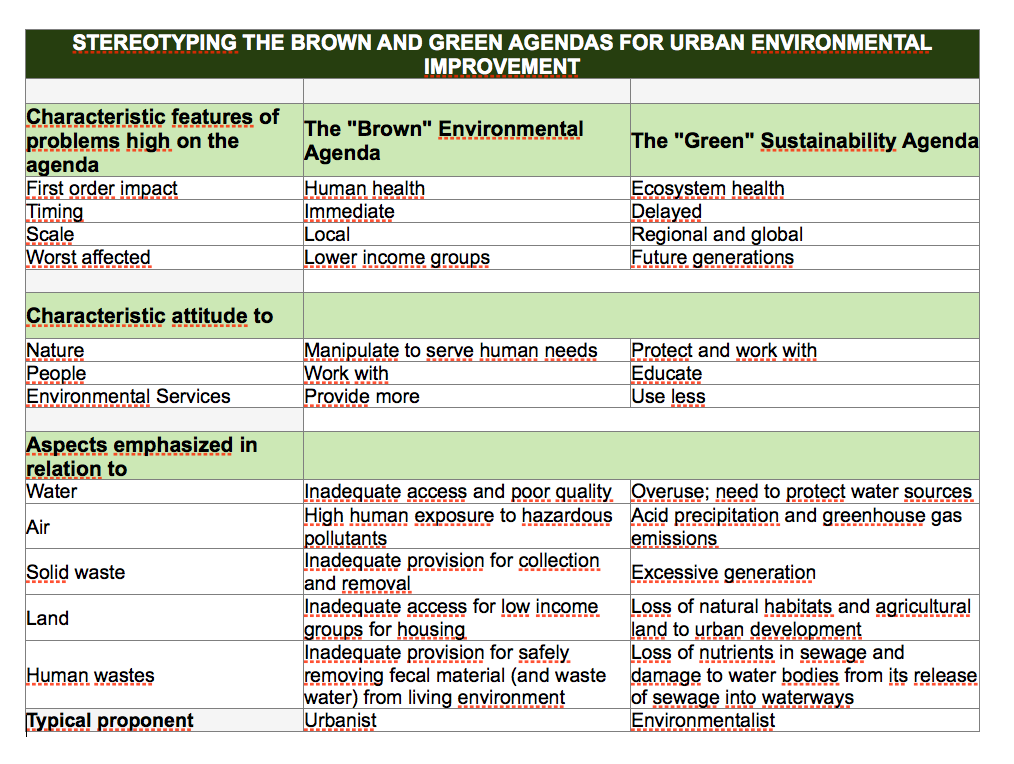
Since the Earth Summit in 1992, international consensus has grown that the global green agenda cannot be addressed until the urgent problems of social deprivation and inequalities within cities are resolved. But the boundaries between global environmental sustainability (green agenda) and urban sustainability (brown agenda) are difficult to define due to their complex interrelationship.
Although these different agendas are often considered separately, in reality they are inseparable. Simultaneously advancements on both agendas are required to make real progress.
Obviously the strong international effort directed towards the brown agenda is aimed mostly at improvements in the living standard of the world's poorest citizens, those who have neither basic services nor adequate housing. Yet, until recently, very few people were questioning the development goal being pursued, or the effect of urban development programs on the global environment. More people are beginning to accept that changing the direction of urban development will require a change in global patterns of consumption, more specifically in energy and resources consumption.
New meanings need to be assigned to the concepts of development and progress, and certain core objectives, which have appeared until now to give structure and meaning to our lives and society, need to change. Instead of looking for ‘more’ we need to search for ‘better’, to seek out quality in the built environment, instead of quantity; so the overconsumption of unnecessary energy and natural resources can finally be avoided.
A Single Approach to Sustainable Architecture
Identifying and developing more sustainable building materials and construction techniques that can minimize energy and natural resources overconsumption as well as waste and that are non-polluting is recognized as an important aspect of sustainable building design.
However, the main question is in which stage of the design process do we have to start thinking about these green aspects? Is it just an addition we have to annex to the project once it is finished?
Is it a mere correction of some aspects of the project?
On the contrary, sustainable issues must be considered at the same time as the project. In fact, it should be a single project, so unnecessary use of energy and resources will be avoided. Fortunately, these questions are increasingly being taken into consideration. Actually, this is what LEED rating systems promote with the so-called integrative process, a comprehensive approach to building systems and equipments in order to achieve high levels of performance, human comfort and environmental benefits; so efficiency and effectiveness are achieved.
Perhaps some projects are designed through this process just to get a higher score in the rating system, but the truth is that it could be a powerful tool in changing architects' conception of the design process in terms of efficiency regarding use of energy and resources.
Designing sustainably, in terms of both buildings and cities, consists on energy conservation/economy and creating spaces that are healthy, economically viable and sensitive to local needs (it is only when a building or a city is occupied that the design intent can be ultimately tested).
At present, the principal objectives focus on reducing the energy intensity of buildings through the use of insulating materials, low energy lighting and the promotion of natural ventilation, and eschewing non-renewable and potentially hazardous and toxic materials.
Material considerations are an essential part of sustainability. Aspects like the energy that goes into production, the possibility of recycling and/or reuse, the energy costs of transporting building components to the site (geographical availability) or the energy that will be consumed by all the occupants in getting to a building must be taken into consideration. Passive systems are proved to have good results, so this could be a useful place to start. Nevertheless, as was previously mentioned, there are multiple possible approaches to designing sustainably. That is to say, the perfect sustainable material does not exist. Each one has different characteristics that make them unique and more propitious for a certain purpose.
Sustainable development was described in the 1987 Bruntland Commission's report (WCED, 1987) as "development that meets the needs of the present without compromising the ability of future generations to meet their own needs". One can interpret generation in this definition to mean community. As humans are part of nature and its ecosystem, it is not absurd to think about sustainable communities and lifestyles as the foundation for a new conception of (sustainable) life.
One last thought is that clients, designers and contractors must be aware about sustainable design and its benefits. Establishing environmental objectives depending on several fundamental parameters (site and climate, legislation, costs, availability of sources, etc.) is essential for achieving energy and natural resources savings.
Nevertheless, these are not the only people who must be aware of the issue, but also those who will occupy buildings or will inhabit the city. It does not matter how green the design of a building is if it is not used as it was supposed to be. This is, as previously noted, a matter of education.
----
BIBLIOGRAPHY AND REFERENCES
- SIMON GUY and STEVEN MOORE, Sustainable Architectures: Cultures and Natures in Europe and North America; New York, 2005.
- DAVID GIERSON and CAROLYN MOULTRIE, Design Principles & Practices: An International Journal, Volume 5, Number 4 (Architectural Design Principles and Processes for Sustainability: Towards a Typology of Sustainable Building Design).
- DAVID GRIERSON, Design Principles & Practices: An International Journal, Volume 3, Number 3 (Towards Sustainable Building Design).
- JAMES LOVELOCK, The Revenge of Gaia; Penguin, 2006.
- DANIDA Workshop Papers: Improving the Urban Environment and Reducing Poverty; December 5, 2000; Copenhagen, Denmark.
- DANIEL MILLER, Consumption and its consequences; August, 2012.
- UNITED NATIONS, Agenda 21: Earth Summit: The United Nations Programme of Action from Rio, 1992.
- http://www.usgbc.org/
Connect.
Find LEED consultants and professionals with green building skills and experience.
Meet Pros.


Learn.
Relevant education and training to consider.
News.


Why join Poplar Network?

- Learn about green building
- Save on LEED exam prep
- FREE continuing education
- Join the conversation
- Connect with peers