
C-PACE Financing for CapEx and Deferred Maintenance


C-PACE helps commercial real estate owners alleviate the severe backlog in deferred maintenance and necessary capital improvements while boosting NOI.

A poorly maintained building is a compromised system. A roof deteriorates, HVAC systems malfunction or become inefficient, lighting is poor and outdated, building envelopes leak. Building components that fail can cause a domino effect on other parts of the system... It can also create incremental tenant renewal issues or safety problems. Unfortunately, the recent recession has resulted in a significant pile up in overdue capital improvements and deferred maintenance in commercial real estate.
However getting a handle on the scope and priority of necessary maintenance and improvements can make the decision making process complicated. Often real estate investors do not have a significant level of understanding regarding their buildings' complex mechanical systems or the impact on one system from the failing of another.
The lack of understanding can lead to reductions in spending that can fall below the minimum needs of the building. The result can be an exponential cost increase (the opposite of desired savings) that is all but invisible until it is too late.
Some root causes of deferred maintenance or delayed capital expenditures include:
- Lack of capital
- Lack of clear ROI
- Measures not considered a priority
- Low operational bandwidth
Lack of Capital
The #1 reason why maintenance and capital improvements are deferred is due to a lack of capital. Whether this lack of capital is real or perceived makes no difference... The cost of maintenance continues to compound because nothing is happening with respect to the work.
Equity capital may be available, but not committed, because operators or investors are strongly opposed to making any further investments in the property.
While equity capital calls may be technically possible, a lack of political will within the organization can cause paralysis or management may simply choose to hold on to "dry powder" due to economic uncertainty.
Debt may be available, but with poor economics. Even if a second mortgage or incremental debt is an option, conventional bank financing is typically structured to be short term debt (maturity of 5 years or less) and requires a deposit of 10-20% of the loan. While a deal can get done on these terms, it may deliver a negative return on investment (ROI) for the project delivering overall downward pressure on investor returns.
Debt may be out of reach for a property that is over levered or under water.
If the property is over levered, the property owner may already be in default with respect to their debt coverage ratio in their mortgage covenants. While not every situation is this dire, in a building that is under water there is little or no chance of the maintenance or capital expenditure items being addressed in the near term.
PACE: The Route to Boosting NOI
Property Assessed Clean Energy (PACE) financing is a proven public/private partnership model that helps CRE owners overcome the principal barrier to investment in energy efficiency and on-site renewable energy projects.
PACE financing provides commercial, industrial or agricultural building owners up-front funding, typically 100%, of the cost of the energy conservation measures (ECMs). Private financing is repaid in the form of a lien (special assessment) added to the property tax bill, for a term that matches the useful life of the measures, for up to 20 years. The ECMs must deliver savings (greater than the annual PACE assessment payments) and/or generate incremental energy and be permanently affixed to the property.
PACE assessments run with the property. This structure not only allows the assessment to stay with the building upon a future sale, but also allows the owner to pass payments through to tenants who benefit from the improvements and reduced utility costs.
PACE leverages a proven legal framework and financing structure while focusing tightly on energy conservation measures that deliver projects that are cash flowing. The 90 second video below provides a clear overview of the benefits of PACE.
Indeed, owners often perceive these financing options to be "too good to be true". However a brief presentation on the benefits of PACE financing, and examples of success stories in states such as Connecticut, can often overcome most obstacles.
C-PACE: The Advanced Model
While PACE funding is proven, it is still in its infancy. As of May 2014, twenty five PACE programs across the U.S. are funding, or are preparing to fund, $250 million of projects that are in the pipeline throughout more than 500 cities and towns in nine states and the District of Columbia. California and Colorado were pioneers in commercial PACE financing.
However, perhaps no program is as advanced as Connecticut's. The Connecticut Property Assessed Clean Energy (C-PACE) streamlined system, which is led by the Connecticut Green Bank, is leading the nation in both its design and sustainability. Indeed, the Connecticut Green Bank (formerly CEFIA) is the first of any program in the U.S. to successfully securitize and sell a $30 million tranche of C-PACE loans to a private investment group.
C-PACE pioneered a unique underwriting model, leveraging Sustainable Real Estate Solutions' building energy performance software platform, which allows CRE owners to objectively view their appropriate deferred maintenance or capital expenditure items through the lens of energy conservation.
The collaboration between the Connecticut Green Bank and Sustainable Real Estate Solutions standardizes and streamlines the process from preliminary assessment to ECM installation, the value of which cannot be overstated. The methodology introduces necessary third party checks and balances that span the underwriting process requiring that all energy conservation measures deliver a savings to investment ratio (SIR) greater than one, thereby offering a clear path to ROI.
C-PACE financing allows qualified CRE owners to receive 100% long term, affordable fixed rate financing to invest in cash flow generating energy conservation measures. The financing is off balance sheet (no recourse to the investors) and is repaid through a property tax lien over up to 20 years. Other financial benefits include MACRS accounting treatment and a Business Energy Investment Tax Credit for renewable energy measures.
For multiple tenant retail, office and multi-family buildings (5 units or greater), C-PACE can solve the "Split Incentive" problem that can occur when a misalignment of interests arises between the building owner and her tenants. Most lease structures can accommodate C-PACE financing, allowing the owner to undertake energy efficiency measures and pass the tax assessment on to tenants.
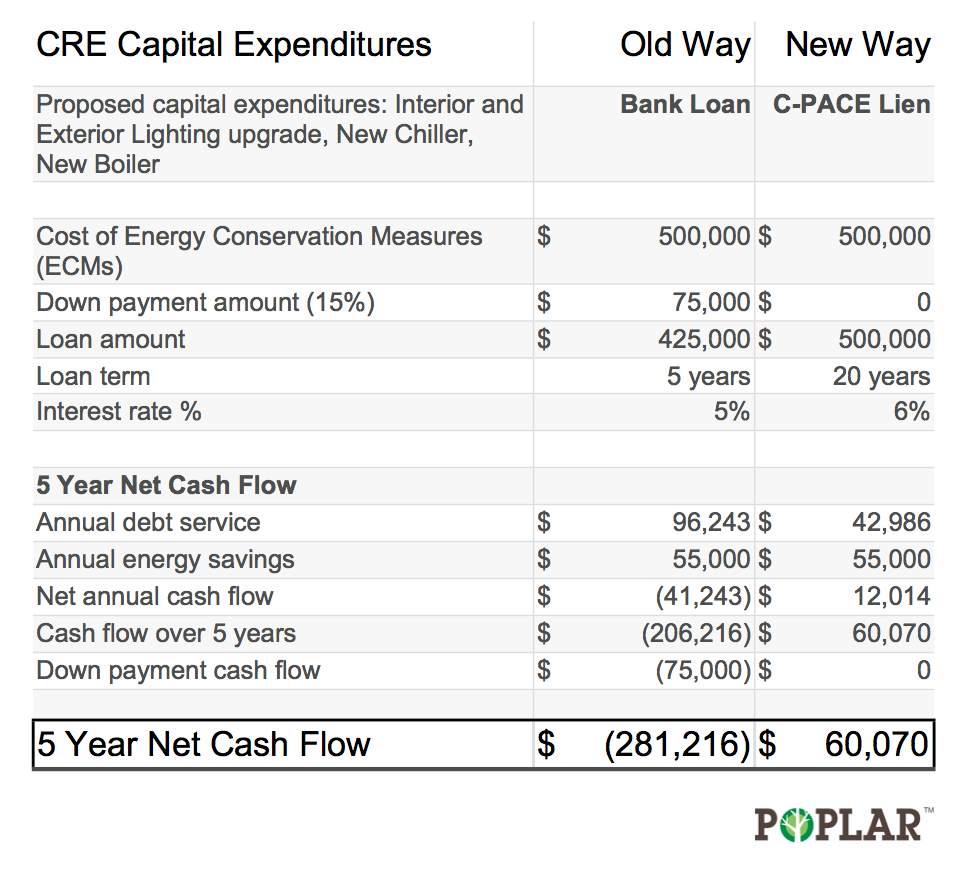
The many benefits of the C-PACE financing approach often shifts the decision making philosophy from one of owners being forced to endure a money losing expense to anticipating the future benefits of a sound investment. This is a very compelling alternative to conventionally structured bank financing. The example below illustrates a hypothetical scenario comparing the relative cash flows of bank financing vs. a C-PACE lien.
Prioritization of Energy Conservation Measures
Addressing capital improvements and deferred maintenance items is a notoriously low priority for real estate owners and investors.
However, by re-examining these items through the lens of energy conservation, C-PACE financing can not only address the building's needs, but also reduce operating expenses, generate incremental cash flow and increase property value.
Because the yields on energy conservation measures vary according to building type, ownership, lease structure and geographic location, it may be helpful for owners to prioritize ECMs one by one and consider whether they fall into the following categories. We have found that solar photovoltaic investments and lighting retrofits and represent significant opportunities in many buildings, however by no means do C-PACE benefits stop there.
C-PACE approved ECMs include:
- Renewable energy investments (e.g. photovoltaics)
- Updated lighting
- New HVAC equipment
- Efficiency controls
- Building Management System (BMS)
- Chiller/Boiler upgrade
- Efficient hot water systems
- Insulation
- Building envelope improvements
- Fuel switching (shifting from oil to gas)
- Water conservation measures
- CHP/Microgrid projects
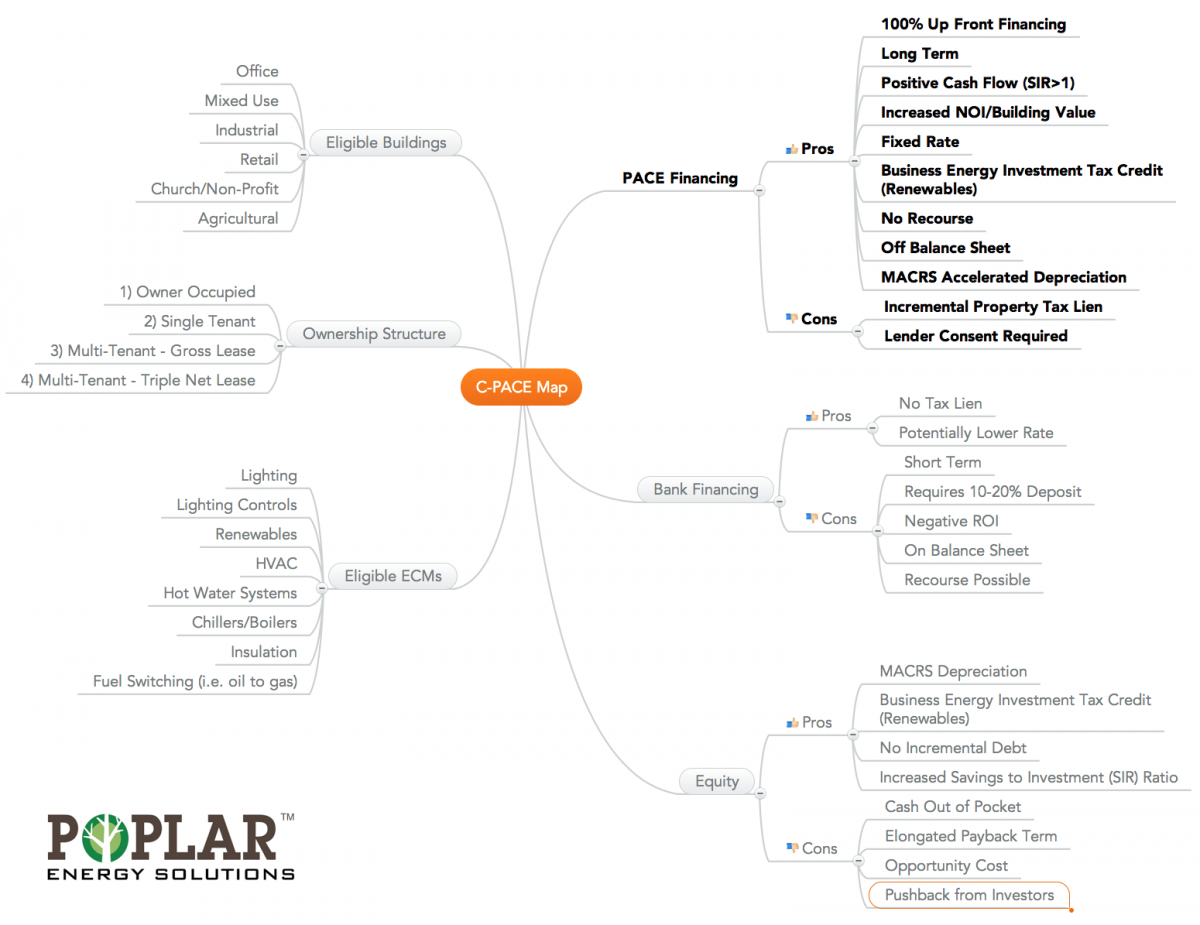
An overview of the pros and cons of each financing approach, eligible building types and common ECMs can be seen in the C-PACE Map below.
Leveraging the C-PACE Support Structure
Lease negotiations, tenant complaints, a blown water pipe, K1 season... These are just a few of the things CRE managers have to deal with.
A lack of bandwidth can hinder the evaluation and prioritization of things as exciting as deferred maintenance and CapEx. Fortunately, getting started with the C-PACE program is easy.
Commercial real estate owners, asset managers, and/or property managers should not be afraid to avail themselves of the C-PACE website. The site offers an overview of the process and a list of professionals who are available to guide owners and prioritize their ECMs (obviously they're doing this as part of their business development process).
When all else fails, hire a professional. A preliminary evaluation to determine a "go/no go" can be completed in as little as 48 hours. This saves the real estate owner valuable time and money while helping them learn at the same time.
Underwriting Requirements to Qualify
C-PACE financing is most well-suited to owner occupied, single tenant or multi-tenant gross or triple net lease properties including office, retail, industrial, agricultural and multi-family buildings with more than five units.
However, as with any bank financing, the C-PACE underwriting process requirements will not suit every building's ownership structure and/or financial situation.
Buildings with a loan to value (LTV) ratio of less than 20% are good candidates for C-PACE and, because the savings from the ECMs must offer a positive return on investment (usually in the first year), the benefit to the bottom line can be significant. Once a building has been approved through pre-qualification, it undergoes technical and financial review.
The underwriting procedure follows a proven benchmarking process that has resulted in success. Indeed, with the recent securitization and sale of C-PACE liens to Clean Fund, a California based PACE investment group, the process has proven itself to be sustainable and the products attractive as investment grade securities for private investors and funds looking for high quality returns.
You can learn more about boosting your real estate investment returns through PACE and other strategies by reading "Clean Cash Flow™" our upcoming e-book for forward thinking commercial real estate investors. To request a copy please click here.
The pre-qualification process is voluntary and informative. If you think your Connecticut commercial building might qualify for C-PACE financing, a free pre-qualification evaluation can be provided to you (typically within 48 hours) by contacting us here.

Connect.
Find LEED consultants and professionals with green building skills and experience.
Meet Pros.


Learn.
Relevant education and training to consider.
News.


More.

Why join Poplar Network?

- Learn about green building
- Save on LEED exam prep
- FREE continuing education
- Join the conversation
- Connect with peers