
Brazil's Curitiba Exemplifies Sustainable Development


Rio de Janeiro and Sao Paulo may get most of the world’s cinematic love for Brazil, but the truth is that Curitiba is one impressive epicenter of innovative urban design.
With roughly 1.8 million inhabitants, Curitiba is Brazil’s eighth largest city... but when it comes to eco-friendly feats, it’s arguably "Número Um".
Once a pleasant combination of agricultural prosperity and successful marketplaces, Curitiba began its sustainable urban planning process in the 1940s, followed by a significant expansion starting around 1950, that was unlike anything Brazil had ever seen before.
Today, Curitiba is both the economic and cultural epicenter of southern Brazil, but it is also regarded as one of the best places to live in South America. The city is located near the southern tip of Brazil, close to Argentina and Uruguay.
Curitiba's excellent reputation is due, in large part, to the innovative urban design that it has continuously embraced for over 70 years. Specifically, Curitiba's earliest planners saw progressive, sustainable design as a way of functionally addressing challenges more typically left to policy – important challenges such as environmentalism, poverty, and growth.
Curitiba Sustainable Master Plan
First, the cities growth – both in terms of residential living and business was strategically laid out in 1965 by a team of young, idealistic architects and planners from the Federal University of Parana (Curitiba is the capital of Parana, the state in Brazil where Curitiba is located). The team was led by urban planning visionary Jaime Lerner, and their initial proposal became known as the “Curitiba Master Plan.”
This strategic document, which was supported by both community and government, proposed minimizing urban sprawl, reducing downtown traffic and potential congestion, preserve Curitiba's historic district, provide affordable public transit and identified key industrial zones for incoming companies to locate in.
What’s more, Curitiba's infrastructure became centralized to a five-artery pathway radiating outward from the city center. These arteries were then strategically manned with excellent public transportation ranging from express and rapid buses with sporadic stations to “inter-district” and “feeder” buses for shorter journeys. This dynamic offering allows for highly efficient, and affordable, public transportation.
Finally, the plan ensured that each district surrounding the arterial design would be supplied with sufficient education, healthcare, and recreation facilities for its residents. This three-prong public/private approach to design – infrastructure, transportation, & facilities - has allowed Curitiba to thrive.
Curitiba's Green Era
During the 1980s, amid heavy recession throughout Brazil, Curitiba launched a series of environmentally focused programs to further protect the city's urban future.
Planners established a number of parks that were dedicated to the city's different ethnic and immigrant groups and developed "green areas" to be protected from future development.
Curitiba was also pioneering in developing a citywide recycling program to separate organic waste from trash, glass, plastics and metals, similar to LEED's requirements. The city of Curitiba sold the recycled salvage and waste to cover the costs of the new program.
Evidence of Successful Sustainable Design
The proof is in the pudding, so to speak! Curitiba has almost 600 square feet of green space per resident. According to the United Nations Environment Programme, Curitiba’s fuel usage is 30 percent lower than in other major Brazilian cities. Per capita loss due to time spent in severe congestion is approximately 11 and 7 times less than Sao Paulo and Rio de Janeiro, respectively.
What’s more, 70 percent of the city residents actively recycle and they use public transportation for 45% of their trips! Their public transport system carries 2.6 million passengers a day – and does so at 50x fewer Brazilian Real per kilometer than the London Tube (which, by the way, carries about 3 million passengers per day).
Interested in learning more about some of the in-depth, innovation that has allowed Curitiba to flourish as it has? Check out this interview with urban designer and former Curitiba mayor Jaime Lerner, who as mentioned above, led the Master Plan project, from Public Radio International.
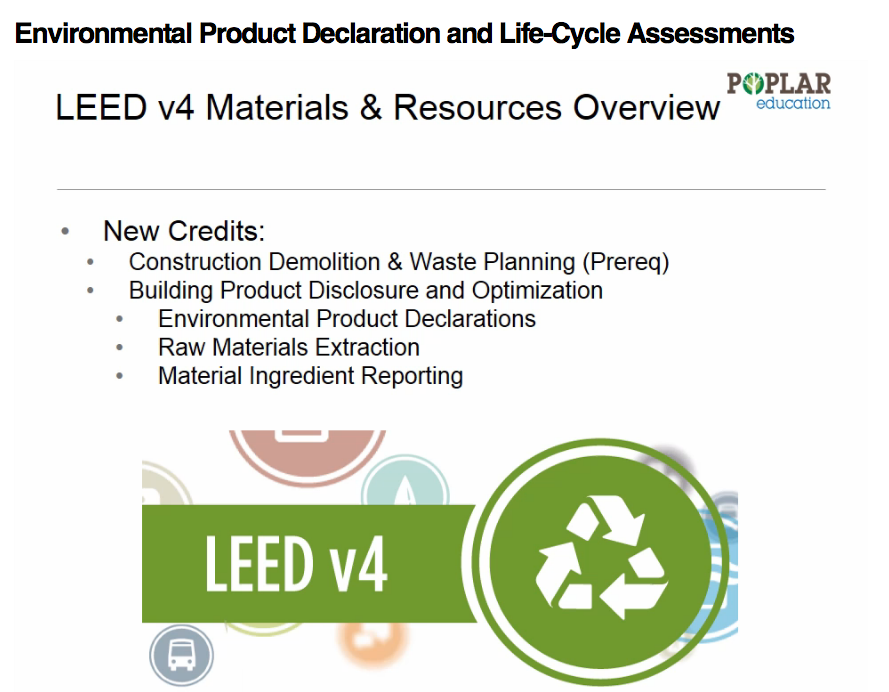
LEED v4 takes green products to the next level.
Learn about how Environmental Product Declarations (EPD) and Life Cycle Analysis (LCA) affects your green building product marketing process in this FREE training course for Poplar members.
Connect.
Find LEED consultants and professionals with green building skills and experience.
Meet Pros.


Learn.
Relevant education and training to consider.
News.


_itok-GdAYtPyq.JPG)

Why join Poplar Network?

- Learn about green building
- Save on LEED exam prep
- FREE continuing education
- Join the conversation
- Connect with peers