
Are Photovoltaic Solar Attic Fans Effective?


Solar attic fans might be a solution for increased ventilation and reduced energy consumption in your next green building project. But so what?
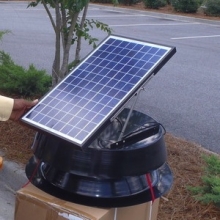
Are you considering solar powered attic fans as a solution for your next residential green building project? If so, this is the article for you!
However, before diving into the efficacy of solar attic fans, specifically, let’s first examine the rather contested history of attic fans in general. Over the years, there’s been considerable debate on their effectiveness. Research conducted by Advanced Energy Corp in the mid-1990’s found that power attic ventilators could actually do more harm than good. Among some of the findings published were issues around combustion safety, excessive moisture and depressurization issues. These potential hazards were directly attributed to the fans’ drawing conditioned air out of the house on account of poorly sealed and insulated attic floors. Naturally, a side effect of this problem was increased overall energy usage, as supplemental air would then be conditioned only to escape just as quickly.
In addition to the above report, the Florida Solar Energy Center presented similar findings from a study of photovoltaic attic fans in 2000. They, too, determined that solar attic fans provided a low return on investment, reducing annual energy usage by a mere 460 kwh/yr.
Willful Suspension of Disbelief
Nevertheless, some proponents of solar attic fans claimed these studies were limited in scope. In fact, the latter was really a singular case study performed on one residence with two PV ventilators. True, there have been many advancements in solar attic fans, which have consequently improved their performance in terms of ROI... And by ensuring proper sealing and insulation of the attic floor, you could omit the concerns raised by the aforementioned AEC study. AND by decreasing attic temperature, in an uninsulated home, you’re likely to positively impact net energy consumption.
So maybe you’re ready to make the move and get a solar powered attic fan. First, you’ll need to start by determining the appropriate size fan. Keep in mind that vents are sized by air flow in cubic feet per minute (CFM).
To determine the appropriate fan size, follow these steps:
- Calculate the volume of your attic (L*W*H)
- Multiple the volume by the number of air changes per hour (a good standard is 10 air changes per hour).
- Divide by 60.
Alternatively, the Home Ventilating Institute (HVI) suggests multiplying the attic’s square footage by 0.7. The product is the proper CFM for your space. As an example, let’s consider an attic that is 1000 square feet. Using the HVI’s equation (1000 sq. ft. * 0.7), the result is 700 CFM. And regardless of which equation you utilize, you’ll need to add 15% for steep roofs and 15% for dark roofs. To determine the soffit intake vent area, you’ll need to divide the CFM by 300.
Now that you know the size, you can consider your purchase. Remember that utilizing a vendor who can also include a battery with the fan is a significant benefit, as the battery will ensure that the fan continues to run as necessary even when the sun disappears. Finally, I suggest installing a thermostat to regulate the fans usage and increase its overall lifespan.
If you have experience with roofing and are comfortable with the installation process (you’re a knowledgeable handy man or better), then consider taking on the job yourself.
But... So What?
It begs the question though, is a solar attic fan really necessary in a truly green building? Is it even green? Or is it just a gimmick.
For an existing residential property, the best, long term approach to reducing air conditioning loads in the summer is to add a thick layer of insulation to your attic floor to keep the attic heat out of your cool house in the summer. Conversely, this will keep your house warm in the winter. You can always tell the homes that have no insulation in their attics after a snowfall... The well insulated homes will still have snow covered roofs, whereas homes with insufficient or no insulation will have roofs that are free of snow. Why? The heat inside the house is going right up through the roof and melting the snow!
But even if you wanted to cool your attic, is it a worthwhile investment? A solar attic fan can run $250-300 before any installation costs, which could add $200-300 to the price. Per the Florida Solar Energy Center report mentioned above (which measured the effectiveness of two units) the payback could be as much as 20 years. Even in a relatively high cost per kWh state, such as Connecticut where electricity approaches $0.17 cents per kWh, it means a 10 year payback.
However, if you are building a new green building project, would a solar attic fan be needed to cool your new attic? Doubtful if the home is well insulated. And just because it's solar powered, does it make sense in terms of an investment? It sure doesn't seem like it.
Connect.
Find LEED consultants and professionals with green building skills and experience.
Meet Pros.


Learn.
Relevant education and training to consider.


Why join Poplar Network?

- Learn about green building
- Save on LEED exam prep
- FREE continuing education
- Join the conversation
- Connect with peers