
3 Green Investments: Yieldcos, Energy REITs and Crowdsourcing


The return on investment (ROI) available through energy conservation measures, by some accounts, is our largest opportunity for wealth creation in the U.S.
Indeed, McKinsey reports that, in the residential sector alone, more than $1 trillion in value could be unlocked in the next six years through measures that include upgrades to our lighting, HVAC and insulation.
And where there is value to be unlocked, there are usually investment opportunities.
So, while individuals can take on ECMs on their own, there is also an opportunity for investors to make money by investing their cash in others ECMs, or renewable energy projects.
And while these investments are sometimes limited to accredited investors, these are not necessarily considered high risk. Indeed, they could be akin to investing in the utilities sector, a class of equities that's as stodgy as it gets.
But for non-professional investors who are looking for consistent yields and predictable performance, utilities have been very popular for decades. Indeed, utilities are the original "widow and orphan" stock.
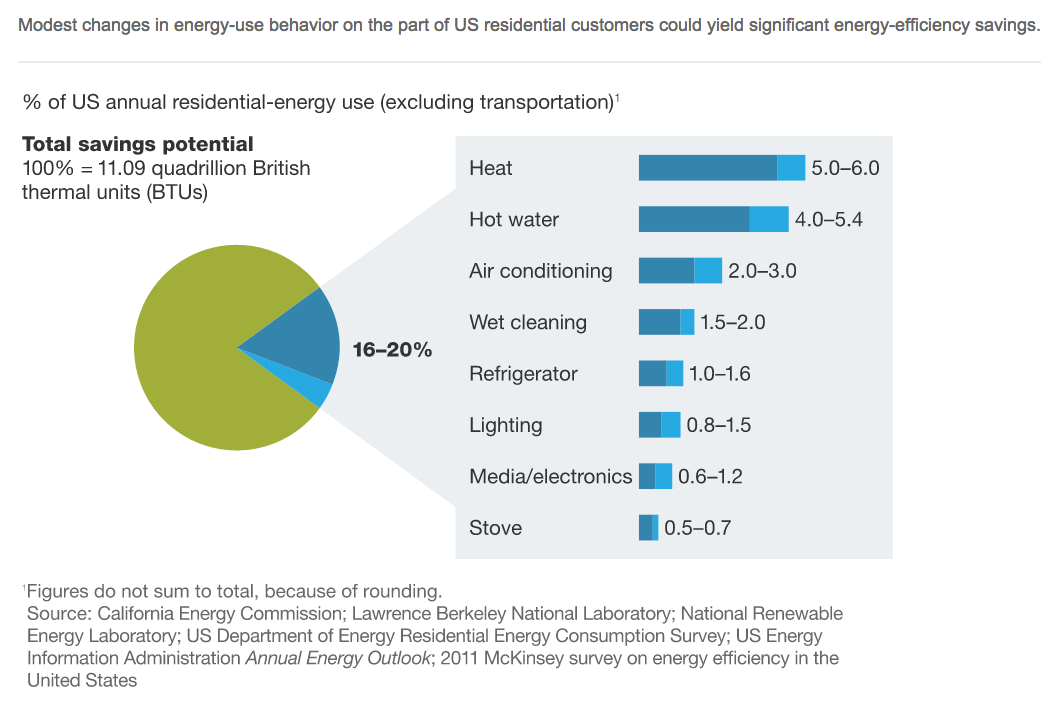
In this article we'll look at three new energy investment structures, and examples of each, that aim to provide access, and opportunities for returns, to individual investors.
Yieldco:
What is it? A Yieldco (or Yield Company) is a relatively new renewable energy or energy efficiency financial investment structure that allows companies to pool together cash producing assets such as clean energy installations of solar photovoltaic arrays, large geothermal installations, wind farms and other unconventional energy producers, and offer the assets to investors.
Yieldcos are aptly named because they are designed to distribute all or a majority of their earnings as dividends to their shareholders. As some Yieldcos are publicly traded, individual investors have the opportunity to invest in renewable energy projects with less commitment and risk than an alternative of, say, installing a solar array on their home or property.
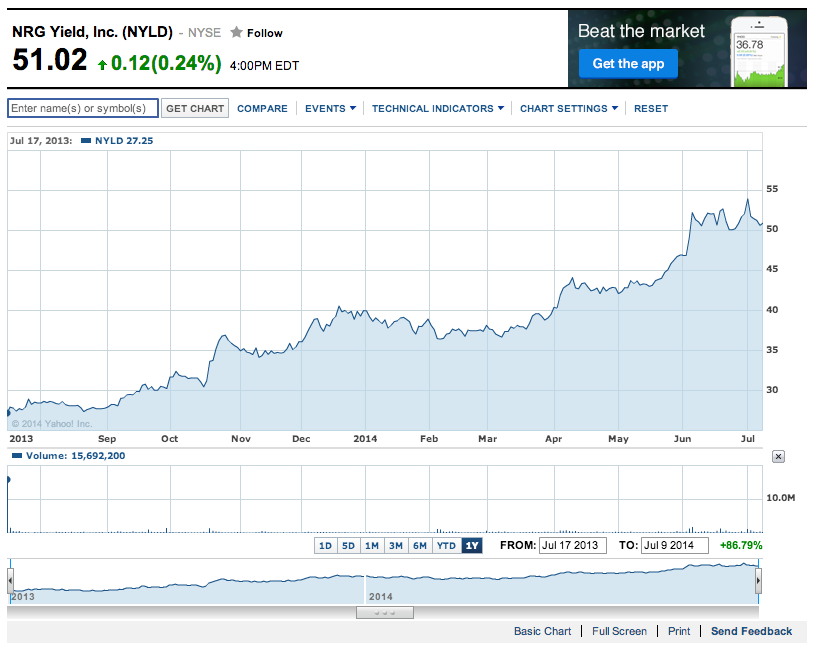
Example: NRG Yield; NYSE: NYLD; Price as of this post: $50.90 - Dividend Yield: 2.7%; Description from Annual Report: NRG Yield, Inc., or the Company, is a dividend growth-oriented company formed to serve as the primary vehicle through which NRG will own, operate and acquire contracted renewable and conventional generation and thermal infrastructure assets.
The Company owns a diversified portfolio of contracted renewable and conventional generation and thermal infrastructure assets in the United States.
Energy REIT:
What is it? The term "REIT" stands for Real Estate Investment Trust. The REIT has existed as a business investment entity for over 50 years and was originally conceived as a way for individual investors to indirectly participate in large scale, income producing real estate projects, without having to purchase the real estate themselves.
As the name suggests, REITs primarily focus on real estate related investments. However there are many types of REITs including those that invest in a single type of real estate (retail, office, industrial, residential, etc.) as well as mortgage and equity REITs. REITS may be publicly traded or private (non-traded).
To qualify, a REIT must comply with a variety of organizational, operational and financial tests, one of which is that the REIT must distribute at least 90% of its taxable income to shareholders to avoid corporate level taxation.
Energy REITs are relatively new concepts in the REIT world. Indeed, the IRS is currently accepting public comments while it considers whether to allow REIT structures that would invest solely in particular types of solar energy installations.
To date, Energy REITs are those that either invest in assets focused on energy efficiency (fixtures such as lighting, HVAC, sensors, etc.) that are considered real property.
Another flavor of energy REITs is focused on financing renewable energy projects. An example is the recent financing by Hannon Armstrong Sustainable Infrastructure (HASI) providing the debt for SunPower's residential solar lease program. SunPower (SPWR) offers solar leases to residential customers so that they can have solar energy installed on their homes with no money out of pocket.
To comply with the various REIT tests, a REIT must limit the number of pure play renewable energy investments it has to a small percentage of its overall portfolio.
Example: Hannon Armstrong Sustainable Infrastructure; NYSE: HASI; Price as of this post: $14.53 - Dividend Yield: 6.1%; Description from company 10K: We provide debt and equity financing for sustainable infrastructure projects that increase energy efficiency, provide cleaner energy sources, positively impact the environment or make more efficient use of natural resources. We began our business more than 30 years ago, and since 2000, using our direct origination platform, have provided or arranged over $4.5 billion of financing in more than 475 sustainable infrastructure transactions.
Over this period, we have become the leading provider of financing for energy efficiency projects for the U.S. federal government, the largest property owner and energy user in the United States. From our IPO in April 2013 to December 31, 2013, we have completed approximately $632 million of sustainable infrastructure transactions.
Crowdfunding:
What is it? Perhaps the most well known crowdfunding sites are Kickstarter and IndieGogo (which Seth Godin reports is easier to use), where individuals can invest or pledge to fund a particular project that is in development. However, because the SEC prevents these crowdfunding sites from offering returns on investment (ROI), project owners offer gifts or products in return for the funding.
Example: In the renewable energy space, Mosaic is a pioneer in crowdfunding solar energy installations that allows individuals to invest and receive positive returns for investing in residential and commercial solar projects.
Opportunities to invest on the site, which some consider to be the "Kickstarter of solar", are very limited due to the fact that Mosaic investments are currently restricted to residents of California.
However, Mosaic is working on expanding the number of projects available to individuals in other states. While it is not publicly available yet, in my home state of Connecticut Mosaic has partnered with Sungage Financial and the Connecticut Green Bank (formerly CEFIA), which oversees green building financing programs such as C-PACE, to allow Mosaic to offer Green Bank solar financing products as investment opportunities to Mosaic investors.
A press release on this partnership indicates that this will be limited to accredited investors only (perhaps because the JOBS Act is still being fleshed out). Mosaic is currently offering investments to California residents who are not accredited.
There are other startups that are exploring crowdfunding strategies in renewables and energy efficiency projects.
Examples of such companies include New York based Divvy and SunFunder. Divvy is an online platform for community organizers to crowdfund (to receive donations toward, not investments in) clean power systems and other green infrastructure projects. SunFunder aims to address the 2.5 billion people worldwide who still lack access to reliable electricity is a solar finance ecosystem that aims to catalyze billions in financing into the off-grid and grid deficit solar market. Unfortunately, for the relevant purposes of this article, neither offers a return on investment to participants.
As mentioned above, the crowdsourcing aspect of the JOBS Act is currently under review and receiving public comment through the SEC on whether to relax the rules regarding the size, nature and scope of crowdfunding investments by non-accredited investors. Because the SEC has not completed writing the rules covering crowdfunding, all companies that are offering access to must also provide a disclaimer that they are NOT technically crowdfunding sites.
----
Chart provided by McKinsey & Co.
Note: The information contained herein does not constitute investment advice or an offer to sell securities or a solicitation of an offer to buy securities. None of the information contained in this post is a recommendation for any investment platform, or investment in any securities.
Connect.
Find LEED consultants and professionals with green building skills and experience.
Meet Pros.


Learn.
Relevant education and training to consider.
News.


Q&A.


Why join Poplar Network?

- Learn about green building
- Save on LEED exam prep
- FREE continuing education
- Join the conversation
- Connect with peers