- Home
- Directory
- Topics
- Energy & Atmosphere
- C-PACE
- Demand Response
- Energy Audits
- Energy Management System
- Energy Storage
- Fuel Cell
- Geothermal Heating
- Green Power
- HVAC
- High Efficiency Furnace
- High Efficiency Water Heater
- Insulation
- LED Lighting
- Lighting Controls
- Lighting Power Reduction
- Lighting Retrofit
- On-Site Renewable Energy
- Optimize Energy Performance
- Renewable Energy Supplier
- Solar Attic Fan
- Solar Photovoltaics
- Solar Pool Heater
- Solar Thermal
- Small Wind
- Smart Thermostat Installation
- Zero Energy Buildings
- Green Building Rating Systems
- Green Business and Careers
- Green Data Centers
- 179d Green Building Tax Deduction
- Additions & Remodels
- Architectural Design
- Commissioning
- Conscious Capitalism
- Green Building Insurance
- Green Commercial Buildings
- Green Homes
- Green Manufacturing
- Green Marketing
- Green Risk Management
- Green Jobs
- Health and Physical Activity
- Interior Design
- Property Assessed Clean Energy (PACE)
- Telecommuting
- Tiny House
- Vertical Farming
- Green Credentials
- Indoor Environmental Quality
- Location and Transportation
- Materials & Resources
- Sustainable Sites
- Water Efficiency
- Energy & Atmosphere
- Q&A
- News
- Education
- FAQ
- Contact Us

Programmable Thermostat: Cut Energy Costs by 20% with This Cheap Retrofit


Programmable thermostats are a cheap retrofit that can cut energy costs for heating and cooling by up to 20%.
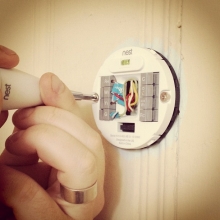
Home Depot claims that by switching from a manual to a programmable thermostat, you could save as much as $180.00 per year on your energy bill.
The Environmental Protection Agency (EPA) reports that programmable thermostats, which allow the user to set automatic temperature increases and decreases, can cut heating and cooling costs by 20%. The EPA estimates that an average household spends about $2,200 on energy bills every year, so this could cut them by a significant amount. Switching from a manual thermostat, which does not have this capability, to a programmable model can reduce your energy bill by $180 per year, according to Home Depot.
Case Study: Programmable vs. Manual Thermostat
A programmable thermostat is a no-brainer upgrade that any homeowner or building owner should invest in, because they are inexpensive and have a quick payback.
Most programmable thermostats cost about $30-100, and the EPA says that they can cut heating and cooling costs by 20%. Home Depot says that they can save as much as 33% on heating costs and 15-25% on cooling costs. Manual thermostats are often cheaper, but are unlikely to save as much money in energy costs. The cost saving of a programmable thermostat will quickly pay for itself, making it a smarter investment than a manual model.
For example, this manual thermostat from Honeywell, the CT87K RoundHeat Only Manual Thermostat, which the company claims is the "world's most popular thermostat", costs $25.25 on Amazon. Their basic programmable thermostat, the RTH221B, retails for $23.49. In this case, the programmable thermostat is actually cheaper than the manual, and will save money - clearly a better investment.
However, that basic model is not as advanced as some of Honeywell's other programmable products. Let's compare the "most popular" manual thermostat to the RTH7600D Touchscreen 7-day programmable thermostat, which has a 4.4/5 rating based on over 500 reviews. It retails for $83.54 on Amazon, which is about $58 more expensive than the manual version.
According to ENERGY STAR, the average annual energy bill for an American household is $2,200 (see here). Heating makes up 29%, and cooling makes up 17% of the annual costs, on average. Therefore, the total cost for heating and cooling is usually a combined 46% of the bill, or $1,012 per year. If the programmable thermostat saves 20% of the heating and cooling costs, then it will save $202.40 in one year.
This means that the programmable thermostat has a payback period of less than one year. In fact, the additional $58 that the customer paid for the programmable model pays for itself in about three and a half months. Plus, it continues to save energy beyond the payback period, making this one of the most cost-effective green retrofits available.
If you are replacing a manual thermostat for the energy savings, then you will still see a payback period of under a year. The $83.54 will pay for itself in about 5 months - still a smart move.
Should You Invest in a Smart Thermostat?
While programmable thermostats are certainly better for saving energy than manual, you may wish to go a step beyond these models and purchase a "smart", or learning, thermostat. These thermostats are not only programmable, but adapt to your schedule based on your behavior and inputs. For example, occupancy sensors can tell that a room is usually empty between 9 and 5 pm, and will set the temperature lower or higher in that room, depending on the outside temperature. Popular models of these smart themostats include the Nest, Ecobee, and Honeywell Prestige 2.0 Comfort System.
However, I'd argue that a smart thermostat may not be a worthwhile investment. Typically, they cost $100-500, but their added energy savings arguably do not make up for the high upfront cost. For example, the Nest costs $249, and the company claims that it can save 20% on your heating or cooling bill - which is the same as the EPA's claim for standard programmable thermostats. The Ecobee and Honeywell models each cost about $300, plus the cost of labor for installation.
The catch is that 89% of programmable thermostats are not programmed correctly for energy savings. Since these thermostats do the work for you, they claim to be better than programmable thermostats, but that's not neccessarily true if you just learn how to set your thermostat correctly. Granted, the smart thermostat can adjust itself all the time, rather than just when you're home, so it might save a little more energy, but arguably not enough to offset the high price.
Programming Your Thermostat
Therefore, the key to energy savings is to set your programmable thermostat correctly. ENERGY STAR, the EPA's program, gives some simple instructions for how to use a thermostat here. These are a few tips for saving energy with your thermostat:
1. Program your thermostat to decrease the temperature by 10-15 degrees when you're not home, such as between 8:30 am and 5:30 pm during the work week. It can go as low as 55 degrees F and not freeze your pipes. Simply turn off air conditioning during the summer during those hours.
2. During the winter, lower the thermostat's temperature during normal sleeping hours. Attempt to lower it by 10 degrees F or more, if possible.
3. Most people consider 68 degrees F to be a "comfortable" indoor temperature during cold weather. Try lowering the temperature by one degree each week. Routinely cutting the heat by one degree for an 8 hour period can save 1% on your energy bill, so you can most likely reduce it by 3-4% with this method.
4. When you go away on vacation, lower the heat to 55 degrees F or turn off the air conditioning in the summer. Some thermostats have a "hold" button that allows you to set the temperature until you return.
5. When you have a large number of guests over, turn the thermostats down. Each person heats the room with the equivalent of a 175 W heater!
With some simple planning and programming, you can be just as smart as the smart thermostats on the market!

Connect.
Find members with green building and green business skills and experience.
Meet Pros.



Learn.
Relevant education and training to consider.
News.


Why join Poplar Network?

- Full Year Professional/Business Listing
- Professional Q&A Service
- Save on Exam Prep and CE
- FREE 9.5 Hour LEED CE pack
- Exclusive Industry Discounts
- Connect with Peers