- Home
- Directory
- Topics
- Energy & Atmosphere
- C-PACE
- Demand Response
- Energy Audits
- Energy Management System
- Energy Storage
- Fuel Cell
- Geothermal Heating
- Green Power
- HVAC
- High Efficiency Furnace
- High Efficiency Water Heater
- Insulation
- LED Lighting
- Lighting Controls
- Lighting Power Reduction
- Lighting Retrofit
- On-Site Renewable Energy
- Optimize Energy Performance
- Renewable Energy Supplier
- Solar Attic Fan
- Solar Photovoltaics
- Solar Pool Heater
- Solar Thermal
- Small Wind
- Smart Thermostat Installation
- Zero Energy Buildings
- Green Building Rating Systems
- Green Business and Careers
- Green Data Centers
- 179d Green Building Tax Deduction
- Additions & Remodels
- Architectural Design
- Commissioning
- Conscious Capitalism
- Green Building Insurance
- Green Commercial Buildings
- Green Homes
- Green Manufacturing
- Green Marketing
- Green Risk Management
- Green Jobs
- Health and Physical Activity
- Interior Design
- Property Assessed Clean Energy (PACE)
- Telecommuting
- Tiny House
- Vertical Farming
- Green Credentials
- Indoor Environmental Quality
- Location and Transportation
- Materials & Resources
- Sustainable Sites
- Water Efficiency
- Energy & Atmosphere
- Q&A
- News
- Education
- FAQ
- Contact Us

Nest Thermostat Just Got Smarter by Partnering with Energy Providers


The creator of the Nest Thermostat, Nest Labs, recently partnered with energy providers across the United States to bring added incentives and savings to its customers.
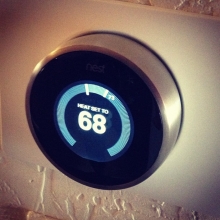
Nest makes the market leading, eponymous, "Learning Thermostat", and was recently acquired by Google.
On Earth Day, April 22nd, Nest Labs announced its partnership with a number of energy service providers across the United States: Reliant (Texas), Green Mountain Energy (Texas, Illinois, New York and Pennsylvania), Austin Energy (Texas), National Grid (Massachusetts and Rhode Island), and Southern California Edison (California).
The company manufactures the Nest "learning" thermostat, which is a smart thermostat that automatically heats or cools the home based on a number of factors, including the user's behavior and inputs, room occupancy (it has activity sensors), the weather and a survey of the user. Within one week, the Nest "learns" the users' behavior and creates an automatic energy-saving schedule. Users can adjust the temperature on the unit itself, or remotely from a smartphone or tablet. The thermostat has special features, such as filter reminders, Auto-Away, which turns down the heating or cooling when no one is home, and Energy History, which tracks the user's energy use and savings.
The Nest is one of the most well-known smart thermostats on the market (competitors include Ecobee and Honeywell). Smart thermostats are becoming popular as an energy saving strategy, because studies have shown that 10% of all American energy is controlled by thermostats, and 50% of an average home's energy is controlled by its thermostat (according to Nest). Nest thermostats can cut heating and cooling costs by 20%, according to the company.
Energy Provider Incentives
Nest's partnerships with energy providers will allow its customers access to incentives and additional cost savings. The over 90 million people serviced by these providers will be able to sign up for special programs, including:
Seasonal Savings: Customers can save 5-10% on their energy bills with this program, which allows the Nest to slowly acclimate the customer to a new schedule during seasonal changes. Overall, the automated schedule will save money, because customers will be more comfortable in lower or higher temperatures.
Rush Hour Rewards: Rush Hour Rewards is essentially a demand response program that rewards customers for saving energy during peak loads, which Nest calls "Rush Hour". The Nest automatically adjusts to accomodate for peak loads, and customers who are serviced by its participating partners receive financial rewards for doing so. Customers often earn $20-60 per season by participating in the program.
Rebates: National Grid in Massachusetts and Rhode Island provides a $100 rebate for purchasing Nest.
These incentives and programs will help customers save even more money and energy with Nest, which will most likely make the learning thermostat more popular, and help it to oust competing brands.
Connect.
Find members with green building and green business skills and experience.
Meet Pros.



Learn.
Relevant education and training to consider.
News.


Why join Poplar Network?

- Full Year Professional/Business Listing
- Professional Q&A Service
- Save on Exam Prep and CE
- FREE 9.5 Hour LEED CE pack
- Exclusive Industry Discounts
- Connect with Peers