
Nanocelluose: The Next Big Green Building Material?


Scientists have recently made a significant breakthrough: developing nanocellulose, a "wonder material" that absorbs greenhouse gases as it grows, from algae. Is this the next big green building material?
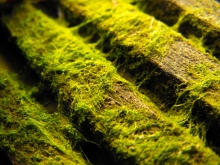
Nanocellulose is exactly what it sounds like: cellulose on a tiny scale. Cellulose is an organic compound that is found virtually everywhere, since it is the main component of plant cell walls. For instance, tree bark, paper, vegetables and fruits are made from cellulose.
Nanocellulose can make materials that are stronger than steel, stiffer than Kevlar, super thin, and very lightweight. It can be used in a variety of materials, from biofuel to incontinence pads to body armor. It also has potential as a component of electronic displays and wound wrappings. Its properties make it an ideal aerogel, which has been used to make a one-pound boat that can hold 1,000 pounds of cargo.
This "wonder material" has been in development for about 40 years, but it is a difficult material to produce on a large, inexpensive scale because very few organisms can actually produce cellulose in nano-form. However, a recent breakthrough could make nanocellulose the next big thing: scientists are harvesting it cheaply and quickly - using algae.
On April 7th, Dr. R. Malcolm Brown from University of Texas at Austin presented his findings in New Orleans at the American Chemical Society conference. He explained that when genetically engineered with vinegar bacterium (which naturally produces nanocellulose), blue-green algae can make nanocellulose using only sun and water. As it grows, it absorbs carbon dioxide, the greenhouse gas most commonly linked to climate change.
Therefore, this recent discovery has been called "one of the most important discoveries in plant biology". Research operations are already moving to larger, outdoor facilities, and nanocellulose produced from blue-green will hopefully be produced on a large scale in the next 5-10 years, according to Brown.
Nanocellulose in Green Building Materials
While nanocellulose has a myriad of applications, it may potentially disrupt the green building materials market when it hits large-scale production. Its eco-friendly production paired with its strength make it an ideal sustainable construction material.
Here are a few examples of how and why nanocellulose could become a component of common building materials:
• Since nanocellulose is transparent, strong and thin, it can replace plastic or glass. Therefore, it can be used in screens and windows.
• Composites made from nanocellulose have properties similar to steel, but are stronger and more lightweight - meaning that they could become a component of structural materials for buildings.
• In some forms, nanocellulose has insulative properties. As "bio-foam", it may be used for insulation.
Is Nanocellulose Really Sustainable?
While it's true that algae absorbs carbon dioxide while it produces the nanocellulose, it will also release that carbon dioxide when it breaks down as waste or is burned for fuel, meaning that it is essentially carbon-neutral, but not carbon negative. Therefore, it cannot permanently remove carbon dioxide from the atmosphere and solve climate change. Proponents of carbon sequestration, which is the long-term capture of carbon dioxide in reservoirs and other vehicles, believe that this type of technology might slow climate change - but it would not work with something shorter-term, like nanocellulose.
That being said, it is far better to produce a carbon-neutral material, like nanocellulose, than it is to produce the many carbon-positive materials and fuels that we use now. For instance, plastic is made using petroleum, which not only releases previously trapped carbon dioxide into the atmosphere when it's broken down, but also uses carbon-emitting energy to harvest. Instead, using nanocellulose can be harvested using only sun and water - two abundant, carbon-free resources.
Therefore, while nanocellulose will not be a silver bullet for climate change, it certainly deserves its "wonder material" title.
Connect.
Find LEED consultants and professionals with green building skills and experience.
Meet Pros.


Learn.
Relevant education and training to consider.
News.


Why join Poplar Network?

- Learn about green building
- Save on LEED exam prep
- Gain continuing education
- Join the conversation
- Connect with peers